Exclusive Interview - Sudan Scope
A special interview with Mrs. Rabab Baldo, a Sudanese pioneer who has dedicated her life to integrating gender issues into major peace processes since the 1990s, from major Sudanese peace agreements to her ongoing efforts to support women in conflict zones. Winner of the 2025 International Sonzi Peace Prize, and through her work with the United Nations and IGAD, Mrs. Baldo has proven to be a driving force behind the scenes, defending women’s voices in every peace negotiation. In this interview, we review with her the pages of her career and her efforts in building fair and comprehensive peace. We also read from her records about the April 15 war, visions, and prospects for solutions. Peace initiatives in conflict areas have long followed an almost fixed pattern: a ceasefire followed by agreements on power- and wealth-sharing formulas. But is this the only way to sustainable peace? This question arises strongly in light of the failure of many such agreements to achieve real stability. In this special interview, Rabab Baldo reveals her vision for a new initiative that seeks to break this prevailing pattern.
All proposed peace initiatives go toward a ceasefire and then agreements on power- and wealth-sharing formulas. What is the different element you are proposing in your initiative that you believe will make a difference in the prevailing pattern of peace agreements?
This is a fundamental and unfortunately global problem. All peace processes use a known international model or framework, which is power-sharing,” Baldo continues: “Even now, at the global level, and I am one of the people who raise this issue in multiple forums and with a group of African actors, there is a need to conclude peace agreements that lead to transformation and take us out of the framework of power-sharing.”She adds: “Peace agreements based on power-sharing have proven their failure in Sudan. We saw this in the Comprehensive Peace Agreement for South Sudan, the Darfur Peace Agreement (Abuja and Doha), the Eastern Sudan Agreement in Kuwait, and also the Juba Agreement between the transitional government and the armed movements. We have seen it outside Sudan in Congo, Libya, and many other countries that have gone through conflicts.”Baldo attributes this failure to the neglect of a fundamental aspect: “Unfortunately, because they are built on power-sharing, they did not look at the issue of justice and accountability for the violations committed. Despite clauses calling for transitional justice and entire chapters dedicated to it, they focused on the financial side and ignored the judicial aspect of the matter.”She explains the consequences of this neglect: “Since most people demand peace before justice, this has created many historical pains and wounds. Many communities that experienced violence and rape did not receive justice, and therefore did not feel satisfied because their rights were not restored and what they went through was not addressed fairly.”Baldo stresses that the current negotiation framework perpetuates the problem: “Let us agree that all agreements and the entire framework we work with now in mediation depend on power-sharing. Since the nature of the conflict revolves around power and wealth, all armed groups and governments enter into political satisfaction through the distribution of wealth and power. This is an eternal problem, an idea imposed on us in every way.” She concludes this point by pointing to alternative directions: “Therefore, there are those who call for looking at justice first, and for agreements to include real transformation in society, policies, and the use of resources, not just shares to be divided. I have sat in many peace agreements, and if I told you how the process of distributing power and wealth happens, it is mathematical equations based on the proportional representation of each armed group. If you have large representation, you get the lion’s share; if your representation is small, you get the smallest share. It is an unsatisfactory process so far, but unfortunately it is the prevailing one.”
Women’s role emerges as a driving force toward genuine peace, transcending the traditional frameworks of power- and wealth-sharing that often fail to achieve the desired stability. Continuing our interview with Rabab Baldo, we delve into how women can provide a radical solution to crises.
How do women bring about real solutions?
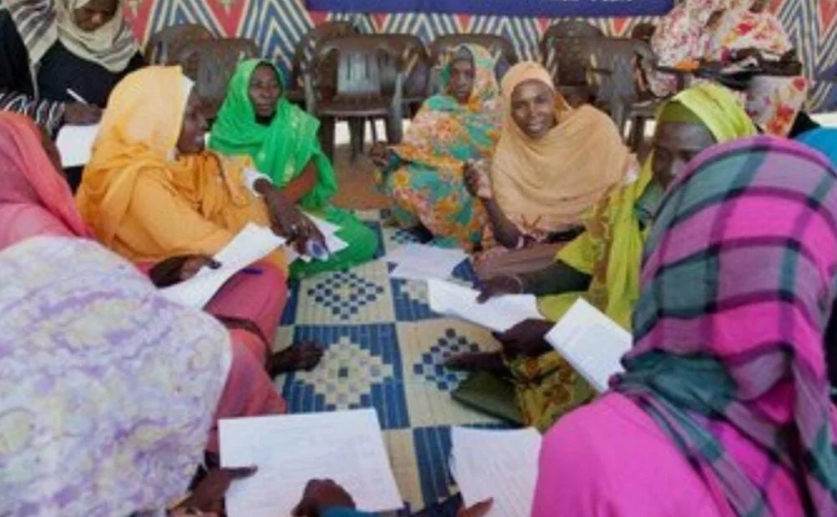
“Women fully realize that the issue of resource distribution is not the essence of peace,” says Baldo. “Therefore, they have brought community initiatives that actually seek to achieve peace, peaceful coexistence, and the rebuilding of the social fabric in areas that suffered social and economic destruction due to various conflicts.” Baldo explains that these initiatives begin with practical and impactful steps: “They have brought local-level initiatives, because no initiative can bring a political solution or end the war without an initial ceasefire. Women have contributed in many countries, and I am very proud that the women of my country have brought initiatives at the local levels, whether in South Kordofan or Greater Kordofan, by negotiating with the army and various armed groups in the region to stop temporary gunfire for limited hours during the day (from 12 noon to 3 p.m.). This allowed people to reach the market, buy necessities, return to continue work in central kitchens, their homes, and emergency rooms, and support their families. These initiatives have helped reduce the food gap in many areas where women created them.” She adds to women’s efforts on the ground: “They also prevented the recruitment of their sons, brothers, and husbands so that the war does not continue. These are limited and simple initiatives, but they have a very great impact in empowering women to influence the ongoing war and contribute to ending it as soon as possible. Regarding future planning, women’s leadership stands out: “Women have also been able to sit together from all colors of the political spectrum and armed groups, and it is well known that Sudan has a large number of armed groups, and they were able to agree on a women’s roadmap and a common agenda. This agenda helps set priorities in different stages, whether political transformation, post-war, reconstruction, or recovery. These are major and very important stages, and if women are not ready for them now, the matter will become difficult. We are ahead of men by stages in organizing our papers, and we have a clear vision that we have worked on.” In the field of advocacy and diplomacy, women have taken an innovative approach: “Women have also thought outside the box in finding another way in advocacy, and they began people’s diplomacy to communicate with people in many countries. These countries have a direct impact on the war in Sudan, whether negative or positive. They were able to communicate through shuttle diplomacy with leaderships in those countries, especially women, to create a kind of feminist solidarity and make the forgotten war in Sudan a priority in different countries. There are many initiatives carried out by women. Also, at the simplest level, they worked on awareness through simple sessions in communities, such as coffee sessions in small rural communities, calling for stopping the war, the necessity of working together, and silencing and transcending tribalism. They work directly in community peace, peaceful coexistence, and bridging the gap that occurred in the social fabric so that we can coexist with each other, especially future generations, because what is happening now will make us hate each other forever and keep the country in a state of continuous wars.”Baldo concludes with regret reflecting the current reality: “Women are making many efforts, but unfortunately everything they do at different levels is ignored by politicians who do not look at it. There is a very large gap in linking what women do with what happens at the political level. Even women’s participation in peace processes, negotiations, and conferences at various levels is weak and timid; only two or three women, despite the number of women who have experience, qualifications, and capabilities, which is certainly much greater than the level of representation or their quota percentages.”
In the search for innovative solutions to conflicts, people’s diplomacy emerges as an effective tool in the hands of Sudanese women. To reveal more details about this unique initiative aimed at ending Sudan’s forgotten war, can we elaborate more on shuttle diplomacy?
Official diplomacy always takes on a tone of seriousness and adherence to channels, but communication between peoples always has a greater impact; therefore, I call it people’s diplomacy,” Baldo explains. “The idea came after many analyses. Women took a very long time to analyze the current situation and the different parties that influence what is happening in Sudan in this ongoing war. Through this analysis and the analysis of the balance of power, nine countries were identified. These countries have a direct relationship with the two conflicting parties and a direct relationship with the ongoing war in Sudan, as I mentioned earlier, negatively or positively.” She adds: “Therefore, women realized through this that Sudan’s war is completely forgotten, and the focus is on other countries. So we decided to make visits to these countries and communicate with official entities, women parliamentarians, civil society organizations, and the media to create awareness about what is happening in Sudan, the dangers of the ongoing war, and the importance of pressuring the two conflicting parties to end this war. The experience, whether in the South or in Sudan now, created momentum and put Sudan’s war back on the priorities of these countries. It was covered by the media, parliament, and many entities in the visited countries.”Baldo also points to the positive impact of this diplomacy on the international women’s level: “It also created a kind of feminist solidarity, especially from parliamentarians in different countries who took up the issue with full commitment and seriousness. They began addressing the issue and pressuring the conflicting parties, noting that Sudan’s resources, especially gold, reach many European countries. Thus, these countries contribute to increasing the suffering of women in Sudan and prolonging the war.” She emphasizes the reminder role of shuttle diplomacy: “Shuttle diplomacy also contributed to reminding these countries of their commitments to the Women, Peace and Security Agenda. We all know UN Resolution 1325 and the other ten related resolutions on conflict-related violence and gender-based violence. All these countries committed not to participate in the suffering of women in other countries in addition to their own. Reminding them of these commitments- that they saw the importance of development and economic growth for themselves but closed their eyes to Sudan’s suffering- had a positive impact. Even now, discussions are taking place in their parliaments, and they are working to find a balance between their economic interests and development goals on one hand, and their commitment to the Women, Peace and Security Agenda on the other.” (Note: Shuttle diplomacy was implemented only in Sudan.)
Did shuttle diplomacy participate in the Comprehensive Peace Agreement for South Sudan?
No, this is a current initiative related to the ongoing war,” Baldo clarifies. “In the Comprehensive Peace Agreement for South Sudan, there was also an initiative led by Sudanese women to open dialogue between women in northern Sudan and women in southern Sudan at a time when the peace issue was a matter of state security. We communicated to give women the opportunity to meet and think, to create a safe space for meeting, and it helped greatly in creating the Women’s Agenda for Peace. There are indeed disagreements between us and divergent positions, but there is a minimum level of consensus among us as women. This helped us in the Comprehensive Peace Agreement for South Sudan, the Doha Agreement, the Abuja Agreement, the Juba Agreement, and all peace agreements that Sudan has gone through.”
In our ongoing interview with Rabab Baldo, we touch on a fundamental question about the diminishing participation of Sudanese women in current peace efforts compared to their prominent role in the past, especially during the Comprehensive Peace Agreement for South Sudan. We also explore the underlying reasons for this decline and the strengths inherent in women’s popular diplomacy.
Despite the historical role of Sudanese women in previous peace agreements, why does their voice seem significantly diminished in the current war? Is this due to weakness in their participation, or has the political practice become more exclusionary? And what about women’s voices that support the war?
This question is very important, and I will answer it as a mediator,” says Baldo. “The main concern of any mediator in any peace agreement is to succeed in creating consensus between the two conflicting parties. If we go back to the literature, you will find that the successful mediator is the one who can reconcile the two sides of the conflict, reach an agreement, and convince them to sign it. This is the main concern of any mediator entering a mediation process between conflict parties." She adds: “Perhaps this is what made many mediators focus only on the two conflicting parties. Few peace processes in which I participated introduced other stakeholders, such as in South Sudan. Few countries introduced stakeholders, but their participation was timid and not actual, or was minimal so as not to obstruct the mediator’s primary goal of bringing the two conflicting parties to an agreement.” Baldo points to the complexity of the current situation: “What happened in this war is that the two conflicting parties completely refuse to sit with each other, so the matter is very complicated for mediators. In addition, any participation of stakeholders must be with the approval of the two conflicting parties. If one party refuses the presence of youth, women, native administrations, or any civil party, for example, it becomes difficult for the mediator despite attempts to convince the parties and remind them of their regional, international, and global commitments that call for women’s participation and the participation of stakeholders in peace-making processes.”She explains that women’s participation depends on the mediator’s flexibility: “Women’s participation remains dependent on the mediator’s flexibility and strength in pressuring the conflicting parties to accept the other parties. If this issue is intractable, it becomes secondary to him. This is not only for women, but for all stakeholders, native administrations, youth, people with special needs, and all different groups in society, to participate as parties to peace-making or as negotiators, even if in the first, second, or third track of the peace-making process.”Even in the Comprehensive Peace Agreement for South Sudan, the process was not easy; it was very difficult,” Baldo recalls. “The mediator was a brigadier general in the army who only knew military language; he was from Kenya (with reservations on names, we all know who the mediators were). Even now, his vision is that the two conflicting parties sit down, stop the bloodshed, and people can live; then comes the stage of talks and political dialogue, where the door is opened afterward for women, youth, and all different groups to engage in the political process.” Regarding women’s efforts in Geneva, Baldo says: “When we went to Geneva, one of the conflicting parties was not present, so we as women refused to be part of this process because we want dialogue between the two parties. We completely refused to sit with one party due to our firm belief in our complete neutrality, our belief in our cause, and that what we want to present is to both parties together. When the presence of both parties became intractable, we sat with the mediation and presented to the mediation team a ceasefire agreement from a feminist perspective, which many women contributed to drafting. This was the first time in history that such an agreement was presented by women to a mediation team, and it was astonishing to the mediation team, as they realized the extent of awareness of Sudanese women on this issue. This agreement helped them in drafting the code of conduct prepared for the two conflicting parties for a ceasefire, which both parties approved.”She highlights other women’s initiatives: “The second assistance provided by women is the local perspective on ceasefire. If there is a problem with a total ceasefire in all areas, why not start with certain areas and expand? The initiative was to have peace markets and safe areas, especially agricultural areas, to help close the food gap and the famine that has begun in Sudan.” Women put forward a vision for relief in the raging situation, and through pressure and women’s vision, relief was delivered,” Baldo adds. “The first relief truck to reach El Fasher was through the pressure exerted by women. They were keen to save the cities affected by relief and currently affected by conflict, and to ensure the safety of all citizens, especially their sisters in conflict zones and besieged areas.” Regarding the historical participation of women, Baldo clarifies: “Women’s participation in the various peace agreements that Sudan has gone through was not easy. In Abuja, Doha, and Eastern Sudan, it was a very big challenge. In Juba it was more flexible due to experience and knowledge, and the leadership wanted to represent women, so women’s participation was flexible but only in the second track. In the first track, women’s participation was very timid, unfortunately from two to about 25.”Answering the question about the weakness of current participation, Baldo says: “The weakness of participation is not because women’s voices are weak. On the contrary, women are now more fierce in ensuring their participation because they are simply tired and have reached the conviction that men will not bring peace to Sudan. They now want to participate in official delegations, in the second and third tracks, and at all levels to be foundational in peace.”Regarding the diversity of women’s voices, Baldo notes: “It is true that there are many women who adopt the agenda of the conflicting parties. This is not because they differ from us, but because of their conviction. If I am a politician and belong to a political party, the party’s line and decisions apply to me as well, to everyone, men and women. Or tribal or regional affiliation and their feeling of marginalization, even though we have seen many female politicians presenting the women’s agenda inside their political parties more than the party agenda. In the current war, we have seen many sisters and brothers who were recruited based on tribal and partisan lines, and this is something natural in conflicts,” and some people’s feeling of marginalization. It is a political game, and everyone pressures with the reasons they see appropriate.“ This is one of the reasons for our retreat as women, because we are now dialoguing and each of us sees that the path she took is the one that will lead to ending the war,” Baldo adds. “Even though we have an unwritten code of conduct among us as women that we are neutral and do not belong to any of the conflicting parties. Our concern is to preserve what remains of the country, preserve the citizens and the country’s resources, and we do not aspire to power nor lean toward any of the conflicting parties.
These are the priorities that have united us for years, and this war has also united us. We committed to not supporting any of the conflicting parties and complete neutrality to stop the war.”Baldo concludes: “There was a retreat after the formation of the Founding Charter because some women went to one side based on partisan or tribal affiliation, in addition to other groups supporting the army. Despite our differences, we always agree on our agenda as women (the differences that united us), and our concern is always one: the country, its security, its resources, and its citizens.”
\



