Research Department - SudanScope

Overview:   

Militias and other auxiliary forces have a long history and play a crucial role in Sudan’s conflict since the second civil war began in the mid-1980s between the regular army and the Sudan People’s Liberation Army/Movement (SPLA). The central government has sought to arm local tribes to help the army fight rebels in Sudan's border regions. Older groups have joined and adopted these militias, which adhere to doctrines urging them to defend Islamic and Arabic identity and address tribal rivalries. Over time, militias have expanded across various parts of Sudan under different circumstances to support the regular army. These militias have been formed, armed, and trained by the government’s military to secure the regime, influence the military balance, or, in extreme cases, replace the regular armies (such as the Popular Defense Forces (PDF) and the Special Mission Forces (SMF). These locally recruited groups have been involved in military and violent activities orchestrated by the state, with the central government in Khartoum increasingly relying on them to fight insurgencies—particularly in the Nuba Mountains, Darfur, and Blue Nile regions—which have experienced violent ethnic cleansing campaigns. State-aligned militias help legitimize authority, while fragile official security forces build broader patronage networks, acting as a pool of manpower for custody and jihad, strengthening ties with local communities, and potentially even suppressing political opposition. Sudan’s state-supported militia groups also contribute to insecurity, political instability, abuses of power, and human rights violations.

During Al-Bashir's Islamist rule from 1989 to 2019, his regime helped powerful militant groups like the Rapid Support Forces (RSF) to grow and entrench. As a result, the RSF's main goal became defending the regime against insurgent groups in Darfur. However, the RSF militia's goals have altered.  The RSF’s incentives have evolved beyond only financial rewards and regime security. Following the popular uprising that ousted the authoritarian regime of Al-Bashir in 2019, the RSF shifted its loyalty towards seizing power.  Since April 15, 2023, the two allied military factions, the Sudan Army Forces (SAF) and RSF, have been involved in a deadly war that has left millions displaced, ethnic-based violence, and lacking in political and social security, nearly a year and a half after a coup ousted the transitional civilian government. Significantly, they have created two unstable political zones in the areas they control, which has encouraged the rise of warlord groups and pro-government militias.

 In this context, this analytical article[1] aims to examine how militarized societies help in combating insurgency, resulting in the establishment of parallel armies that influence the current Sudanese conflict. It also attempts to explore how the growth and proliferation of warlords' militias and allied forces could endanger civic space, obstruct Sudan's path to peace, and affect security in neighboring countries.

An overview of Auxiliary groups, State–allied Militias, and Domestic Politics:

Militias have become more visible in domestic politics in conflict-ridden countries, hampering efforts to promote peace, security, and state-building. Whether they are pro-government groups, auxiliary forces, or locally recruited troops, militias have the potential to incite violence, violate human rights, and, in extreme cases, establish a rival power structure that undermines the state's authority. This phenomenon is especially prominent in fragile states where the state’s monopoly on legitimate force is weak. Governments have historically tried to provide security through aligned militias, often replacing the regular army, particularly in African politics. Factors like government inefficiency, regime security concerns, and both internal and external pressures frequently lead to the formation of paramilitary forces. However, in several conflicts across the continent, opponents and separatists have faced persecution by these forces. Their autonomy and loyalty or disloyalty to the government determine how these militias are classified; their goals and motivations also influence their impact on conflicts (Onamu & Nyadera, 2024). As shown in the table below, these militias can be categorized as either "allied" or "unrelated" to the state.

Table 1: Categorizing Auxiliary Forces and Militias Associated with Conflict in Africa

Militarized groupsAuxiliaryPro-militiasInsurgent groupsTerrorists
Government nexusOfficialSemi-Official, InformalMutinous (non-government actor) Illegal Antagonist (non-government actor).
FunctionsRegular and Irregular Activities  Rather Irregular Activities   warfare activities target the official  enemy army violence, intimidation, and illicit  activities
AutonomyLowHighAutonomous rival Autonomous rival
Political TrendsAlliance regime politicsAlliance regime politics Self-governance -Secession- overthrow the regime  Destabilize and undermine the authority of the central government, establishing a separate state (Caliphate)
ExamplesClan militias, Darwish forces (Somalia), Civilian Joint Task Force (Nigeria).Popular Vigilante Brigades (Angola), Vigilante Group of Nigeria (VGN), Burundi’s Imbonerakure.Azawad (Mali, Tigray front (Ethiopia), FLEC (DRC), Biafra ESN (Nigeria), Ambazonia (Cameroon).Boko Haram and AL-Qaeda in the Islamic Maghreb, and Al-Shabaab.

Source: adapted from (Konečná 2024; Felbab-Brown 2020 and Africa Center for Strategic Studies 2021).

Throughout modern history, militias and other auxiliary groups have been a defining feature of the conflict landscape in Africa. Their actions have influenced events both during and after wars, prolonging hostilities and fostering instability and insecurity. Many state-allied groups have emerged due to the shifting nature of threats to states, the rise of regional armed groups, and the growth of autocratic regimes vying for power (Onamu and Nyadera 2024). Auxiliary forces have often been used to suppress opposition to regimes and have occasionally been involved in sectarian conflicts, ethnic cleansing, and domestic violence, such as the 1994 Rwandan Genocide against the Tutsi, which occurred during the government's conflict with the Rwandan Patriotic Front (RPF), and the 1994 plane crash that killed Hutu president Juvenal Habyarimana (Human Rights Watch, 1999). Furthermore, in response to Séléka (a Muslim coalition), which killed Christians in Central Africa between 2013 and 2014, anti-Balaka violence targeted Muslim communities (Human Rights Watch 2014). Local militias can become sources of conflict and violence between national and regional governments within Africa's internal politics. The presence of regional forces, such as Ethiopia's Liyu Hayil in Amharic conflicts against the state military, can complicate conflict resolution and make federalism more fragile (Tsega 2021). To address the high levels of ethnic violence, instability, and terrorist threats, these forces have grown to pose significant risks to communities and local governments. In Nigeria, West Africa, the rise and activities of auxiliary groups in the northeast, such as the Vigilante Group of Nigeria (VGN) and the Civilian Joint Task Force (CJTF), are closely linked to criminal activities, conflict profiteering, and human rights abuses (Felbab-Brown 2020). In other cases, organized regime militias and pro-government groups, like Angola's Popular Vigilante Brigades, Burundi's Imbonerakure, and Cameroon's Youth under President Biya, have been responsible for human rights abuses and brutality against civil opposition, undermining democratic rights and weakening military professionalism, often reflecting totalitarian and corrupt governance systems (Africa Center for Strategic Studies 2021).

Building on the previous discussion, a major issue that threatens state authority, human rights, security sector reform, peace, and regional stability is the formation and spread of auxiliary groups and militias in unstable countries. These groups may pose a threat to a nation's unity and social cohesion. Addressing this problem requires a comprehensive approach that tackles the root causes of violence, encourages good governance, and strengthens governmental institutions.

A Chronical Context: State-Allied Militias and Domestic Politics in Sudan:

Sudan has been politically unstable for almost seven decades since gaining independence in 1956. This shows how authoritarian governments, violence, and insecurity are all linked. The Civil War is both historic and complicated, with many causes and actors. It started in the south and slowly spread across the country, always threatening security and political stability and making lasting peace less likely. Tribal militias have had significant effects on the course of Sudan's civil wars over the decades. Since the mid-1980s, when fighting spread from the south to the Nuba Mountains and Blue Nile in the north, different governments have tried to get local tribes to fight against insurgents, starting with those living near the areas of unrest in the west and southwest.

The Baqqara group of "pastoralists," especially the Rizeigat and Misseriya, joined the Murahilin Forces, which was an alliance of 27 Arab tribes that formed the Arab Coalition in 1987 (Dahia, 2005). They were the first tribal militias to join the army to fight the insurgency during the conflict. The government used their political, religious, and tribal ties, as well as their desire for land and rewards for their service, to get them to fight. These tribes' military prowess and the government forces' deficiencies encouraged them to join the fight. The government has made extensive use of those locally recruited communities in a variety of violent and military operations in the Nuba Mountains and neighboring South Sudan. In a rhetoric endorsed by the government at the time, the Murahilin were also referred to as Mujahideen (holy warriors) under the doctrine of "Protecting Religion and Arab Identity."

Once the National Islamic Front (NIF) seized power in Sudan through a military coup in 1989, the religious element became the most important aspect. The government's first steps after gaining control included founding the Popular Defense Forces. These forces were initially established on jihad and Islamic principles to fight non- Muslims in the Nuba Mountains and the Blue Nile. From early on, the Islamic movement focused on recruiting Mujahideen, followed by activists, students, and young people, mostly from Central and Northern Sudan (Small Arms Survey 2017).  The main purpose of this militia was to serve as a reserve for the regular army, protecting the regime from potential military and civilian opposition. However, as a unique militia linked to the Islamic movement's leadership, fighters advanced and joined the army, surpassing the Popular Defense Forces in equipment and training. They were intended as backup forces when needed and numbered around 100 100,000 (Small Arms Survey 2017). After the Darfur war unexpectedly broke out, the government tried to establish a new militia to fight the rebellion. This militia was composed mainly of Arab tribes, particularly the "Abbala" (camel herders) from northern Darfur, who were involved in land disputes with non- Arab tribes accused of supporting the rebellion. This militia later became known as the Janjaweed. In response to ongoing uprisings in Darfur, concerns about the vulnerabilities of the armed forces, changing political dynamics, disloyalty among militias, and conflicts among them, the government created the Rapid Support Forces (RSF)- a sophisticated militia made up of Border Guard Forces and several Arab tribes from Darfur and Kordofan.  The RSF gradually deployed to South Kordofan and Blue Nile to defend the regime against rebel groups in Darfur. Notably, the corrupt Islamist regime in Sudan used oil money to heavily fund military operations and security forces to fight insurgencies and maintain power. Most of this spending went toward building networks of patrons, acquiring weapons, paying off potential armed groups, and organizing pro-government and auxiliary groups in cities under the regime's control, estimated to number in the dozens.

Table 2: Distribution of Paramilitaries, Militias, and Enlisted Communities in Sudan as of 2016

RegionMilitia/sCommunity  -Origin
Greater DarfurPDF, Border Guards, CRP, armed nomads, Mahamid militias, Jalul militia, Kibir’s militias, Meidob militias ( Meidob police), RSF, Cross–border MilitiasMahamid,  Rizeiga, abbala Arabs, Mahariya Rizeigat,   Awlad Zeid, Awlad Id, Awlad Kileb, and Naja. The Mahariya, Awlad Rashid, Beni Halba, and Mahadi, Awlad Mansour,Beni Hussein, Missiriya and Ta’aisha,  Salamat- Zeyadiya, Berti, Tunjur, Mima, and Bergid, Meidob , e Chadian Arab and non-Arab s (Tama and Waddayans), CAR and Libya
South and West KordofanPDFMissiriya
Blue NilePDFFellata (Pula), Hausa, Arabs (including the Rufa’a al-Hoy)

Source: adapted from Small Arms Survey 2017.

As the war continued, local community mobilization and the growth and promotion of militias persisted throughout the NIF's time in Sudan, using the same ethnic division strategy and offering tribal groups political and economic incentives by creating political and administrative units specifically for them in Darfur. These militias operated under the government's army with the main goal of supporting the regime and fighting insurgents in Darfur, the Nuba Mountains, and the Blue Nile regions, even though their origins and levels of influence varied. The militias eventually participated in inter-tribal conflict due to longstanding ethnic tensions, land disputes, and battles for resources and power. Similarly, their violations and disloyalty to the government caused widespread instability and insecurity, especially in West Kordofan and Darfur. Additionally, the government sometimes tried to stir tensions between Arab and non-Arab communities by accusing them of supporting armed groups and between the militias themselves, as was the case with Janjaweed leader Musa Hilal.

The most recent paramilitary and pro-government groups were created and legitimized during the overthrow of Al-Bashir's government (1989-2019). Under the leadership of former President Al-Bashir, the RSF paramilitary has grown in terms of ethnicity, financial resources, and political influence. The Sudanese National Intelligence and Security Service (NISS) initially commanded them as border guards, providing the security organization with their paramilitary force. After the overthrow of Al-Bashir in 2019, it was found to be governed by the Armed Forces Law, which has since maintained its legitimacy by being directly under the command of the President of the Republic and the Commander in Chief of the army, as outlined by the 2017 law (The Small Arms Survey 2017). The main role of the RSF paramilitary is to protect the government from rebel groups in South Kordofan, Darfur, and Blue Nile regions. Therefore, it is wise to plan for a bright future for the RSF. Due to its heavy reliance on this force, the government has gradually overtaken the regular army in prominence. Additionally, the group is involved in land seizure, war profiteering, and gold mining in Sudan and Yemen (Global Witness 2019). There have been thousands of deaths, millions of displaced people and refugees, significant ethnic alliances, and cleansing as a result of the two allied military groups (SAF & RSF) engaged in a bloody struggle for political-military dominance during the transition period, nearly a year and a half after a coup overthrew the transitional civil government.

The entire fragile state, deteriorating economy, and the future of social integration, the nation's political system, and the unity of the country are at risk. The conflict is a prolonged regional proxy war involving various internal and external actors, each with its own goals. Over 400,000 people have died due to the deadly violence between the SAF and RSF, which has also caused the world's worst hunger and displacement crisis. More than 30 million people need humanitarian aid; about 13 million have fled their homes” (Donare,2025). The Sudanese economy is in ruins, and several cities are devastated. In this context, the creation and spread of militias by governments—most notably the NIF government since 1989—to suppress rebellion and safeguard the regime have become a security threat that jeopardizes stability, the peaceful political process, and Sudan's fragile path to peace.

The emergence of these militias, like the Rapid Support Forces, has weakened Sudanese political, military, and security institutions and threatens the country's unity. They have grown to match the Sudanese army and even exceed it. Additionally, the lack of government control in the regions where these militias operate can lead to waves of instability and a series of incidents that threaten national security and unity. The ongoing conflict in Darfur and other parts of Sudan has also exposed these issues.

The Proliferation of Armed Militias and Present-Day Politics in Sudan

The battlefield was centered between the SAF and RSF in Khartoum when the conflict broke out on April 15, 2023, and it swiftly expanded to Darfur in the west. Later, it spread to the Blue Nile region and central Sudan. Ethnic cleansing, infrastructure destruction, and a collapsing economy are all results of the increasingly destructive struggle for political dominance between the two proxy warlords, al-Burhan and Hemdti. However, there has been no military prevailing or long-term resolution to the conflict. The RSF still held sway over significant parts of western Sudan's Darfur and Kordofan regions while the SAF and its allies retook Gezira, Sennar, and, most recently, the capital. The RSF and affiliated militias have committed sexual assault, massacres, and ethnic targeting in these regions. This supports the allegations that the RSF violated human rights and committed crimes against humanity. Atrocities against civilians, particularly in western Darfur and Gezira States, have also been alleged to have been committed by the SAF and affiliated militias, as has been reported.  

In this regard, the SAF and RSF, the two warring parties, have launched nationwide recruitment drives, and numerous communities nationwide have taken sides and pledged to send combatants into combat. However, the army is supporting organizations and groups that oppose the rule (such as the dissolved Islamists) to obtain legitimacy for power through military victory. Profiting from loot, the conflict is fueling ethnic animosities, self-defense, and insecurity, all of which have contributed to the growth of armed militias, especially in SAF-controlled areas. Although the RSF has been successful in forming alliances with some warlords, smaller tribal-based militias have been driven out due to force divisions, as the table below explains.

In the Sudanese political landscape, this complexity has increased the visibility of militarization and militia formation within communities. As part of the broader military mobilization called "Armed Popular Resistance," several voluntary groups with tribal and regional backgrounds, including "Mustanfirin," have been formed. Most of these groups operate independently in terms of their organization and funding, although regional differences exist in their recruitment levels and preparedness. The army's main ally and the most active Islamist militia in urban areas, the Al-Bara' ibn Malik Brigade, focuses heavily on recruiting young people. Brigade members use the same slogans and rhetoric as the Islamic movement and its armed factions in earlier periods. Another group, known as "Sudanese Popular Resistance Factions," is classified as an Islamist faction. After participating in the Resistance Committees that aimed to overthrow Al-Bashir, they became allied with the army during the conflict. Their popular nickname is "Qhadiboon bla hudood," which means "Angriest Without Borders." They took part in violent protests, unlike the nonviolent revolutionary resistance committees. This faction expanded during the war, recruiting many young people from local communities and activists in the Resistance Committees, with reports estimating their total strength at 2,000 fighters (Al-Nur 2024).

The main change is that armed struggle groups that agreed to the 2020 Juba Agreement now say they will fight alongside the army under the name "Joint Forces," giving up their neutral stance. Both inside and outside Sudan, especially in neighboring Eritrea, recruitment and training camps have been established. Their goals include power sharing, pursuing personal political ambitions, influencing post-war Sudanese politics, and presenting a united front against civil forces of change and democratic transition. The situation on the ground shows that the "Joint Forces" operate with some military independence and are believed to have an advantage in fighting the "RSF" in Kordofan and Darfur, despite their alliance with the army. With around 60,000 fighters, they are divided into four main groups: The Sudanese Alliance, the Sudan Liberation Movement/Army – Transitional Council (SLM/A-TC), the Justice and Equality Movement (JEM), led by Jibril Ibrahim, the Sudan Liberation Movement/Army (SLM/A) led by Minni Minawi, and the Gathering of Sudan Liberation Forces (GSLF) (Ali. et al, 2025 and Al-Nur 2024). Several militias and other groups have also been mobilized to support the "Joint Forces" cause. Three main factions are reportedly fighting alongside the "Joint Forces," which were formed under the banner of "popular resistance" shortly after the "al-Fashir War" was declared. Although these forces are currently fighting with the army in the central region, "Al-Gezira," and north of "Khartoum," their main bases are in "Al-Fasher" and along the route from the western side to northern Sudan, especially in the "Dabba" area. Many Nuba people in Gezira state have left the SAF and joined the RSF, and the Sudan Shield Forces—Kaikal—have shifted from being allies of the RSF to the SAF amid ongoing fighting between the two sides.

There were an estimated 92 armed groups in Sudan before the current conflict, with 87 of them based in Darfur and 5 operating in Kordofan, the Blue Nile, and Central and Eastern Sudan (Sky News 2023). Tribal and ideological militias have proliferated in Sudan since the collapse of Khartoum and the capture of Gazira State by the RSF, who also established a presence in central Sudan and southward toward the Blue Nile State. Their alliance with both sides of the conflict, particularly the SAF, has influenced the timing and terrain of the conflict. While some militias are formed and joined for military purposes, others do so for self-defense, political power (as in the case with the Islamists), or financial gain from the conflict. The SAF government recruits, trains, and uses these militias to fight and obtain political advantage. Tribal warlords and social fragmentation result from their recruitment, which is typically based on political, ethnic, and regional ties. These militias' classification, roles in the ongoing conflict, and influence on Sudan's current political landscape are as follows:

  1. Armed Forces and tribal Militias Allied with SAF

First: Armed Movements and Militias Allied to SAF:

The Joint Forces (SLM/A-Minawi, JEM-Jibril Ibrahim, SLM-Tambour), Sudan Shield Forces-Kakal, Al-Bara' bin Malik Brigade, and their respective Islamic factions are among these groups. All of the Sudanese states, including Al-Jazirah, Sennar, North Darfur, North Kordofan, and Eastern Sudan (Al-Gadarif and Red Sea states), host these forces. They may operate jointly or separately in these regions. Al-Jazirah state has a strong Joint Force presence in its cities and villages, effectively recruiting many people from "kanabi," or marginalized areas, along with displaced individuals from western Sudan and those in auxiliary roles. Additionally, due to their origins and ethnicity, some RSF soldiers have joined the Al-Bara' Brigade and the Joint Forces. In the towns of Al-Hasaheisa, Madani, and Arbaji, the Sudan Shield Forces, Joint Forces, and Al-Bara' Brigade maintain training facilities, recruitment offices, and administrative offices. Together with Islamist groups Al-Bara and Abdullah Jama'a, and Mustanfirin (Volunteers), which are split between the SAF and the Al-Bara' bin Malik Brigade, the SPLM-N-Agar faction operates in Sennar.

Islamist groups operating in the Northern State, specifically in the Dabbah and Merowe localities, include the Strategic Battalion and the Special Mission Forces, along with the Al-Bara' bin Malik Brigade. Both are currently protected by the General Intelligence Service and have links to the now-defunct National Congress Party, also known as the “Shadow Battalions.” Similar to the Popular Defense Forces during Sudan's Islamist regime, mobilized groups and popular resistance are also prominent in the state. In addition to the Sudan Liberation Movement and Army-Minawi, the Tambour group is well-established in the area and operates in the Red Sea State. With a sector established in the state and offices in each area, the Islamic faction (Al-Bara' bin Malik) is the most powerful militia in the region. It is joined by the Sudan Shield Forces - River Nile Sector and the Sudan Liberation Movement - Minawi. Popular resistance groups known as "the Mustanfirin," which are increasing in North Darfur, support the army and joint forces. During the siege of El Fasher, local youths and the Zamzam camp organized armed units to break the siege. Several entities have begun actively participating in military operations. This also applies to militias and armed movements in North Kordofan State, which consist of various factions. Several Islamic groups operate alongside the Sudan Shield Forces (Kaikal), the Joint Forces-Abdullah Jina, and the Al-Bara'a Brigade. These include the 'Bonyan Marsous' (Robust Structure) group and the strategic battalion, which has about 500 members, most of whom are outlaws. Additionally, the state hosts military units based on local tribal groups, such as Abu Jaba's army, which is composed entirely of Hamr tribe members affiliated with the Islamic Movement and fled to the state after the RSF seized Al-Nuhud.  The Nuba and Shawihit tribes are also part of the Kordofan Alliance, led by Wad Ibrahim. The Special Mission Forces, a combined unit of the army and security forces, are also part of this alliance.

This classification makes it clear that armed groups and militias have unique regional and ethnic affiliations. The most prevalent groups in these states are the Sudan Shield, the Al-Bara'a Islamic faction, and the Darfur movement factions, in that order. They continue to recruit, deploy, and empower forces in these areas while fighting directly alongside the army in conflicts with the RSF. Islamist factions, marginalized people, those with criminal histories, and former RSF members make up the majority of recruits in these militias and forces.

Second:  Locally Controlled and Reinforced Militias commanded by SAF:

Numerous local and irregular armed forces are trained and supervised by the army. Especially in Darfur and the Red Sea States, these groups are mainly formed along tribal or ethnic lines. An estimated 5,500 fighters, mostly from the Tamah and other local tribes, make up the Sif Tamah and Sadiq Al-Fakah forces in North Darfur, western Sudan. At El Fasher, these forces are receiving army-led training. Between 800 and 1000 fighters comprise the "Dagu-jwa" forces, which are part of the joint forces. These troops are usually used against the RSF when needed and as mercenaries to take advantage of leftover military equipment after conflicts. In the Red Sea State of eastern Sudan, other groups formed similarly. With full support and coordination from the SAF, various armed groups emerged after the conflict started, and some set up training and preparation facilities in Eritrea. Ibrahim Dawood leads the United Popular Front for the Eastern Region, Ibrahim Dunya heads the Eastern Sudan Liberation Movement, Mohamed Taher Betai leads the National Movement, and Mohamed Agdef leads the Beja Congress- the Unified Leadership (Ali, A, 2025).  A group of local recruits and volunteers who have enlisted in the army joins them.

Particularly in the Red Sea State region, all those groups were formed on a tribal basis, with political influences across social structures. Alongside the armed forces, only the North Darfur organizations—Dagu-gwa Forces, Saif Tama, and Al-Sadiq Al-Faki—are involved in military operations.

Third:  Regionally Tribal –Based Militias and Parties:

With tribal and regional origins, this category of armed factions and parties either pre-existed or were formed after the conflict began on April 15, 2023, in the states of Kordofan and Darfur in the west, and the Red Sea in the east. Among the groups involved are ethnic political organizations and armed militias. The Hamr (Hamar Union (Sar)), which organized a 5,000-strong force to defend its territory in West Kordofan in cooperation with the army, and the "Humr" branch of the Messiria tribe in West Kordofan are two examples of tribal armed factions supporting the army in Kordofan (AL-Nur 2024). In South Kordofan, some Nuba tribes are defending key cities, especially Delang and Kadugli, alongside the SAFCF, along with the Masalit, Zaghawa, and Meidob tribes in North and West Darfur. In eastern Sudan, particularly in the Red Sea State, political groups with ethnic ties have formed and split. These include the Beja Congress, led by Mousa Mohamed Ahmed; the National Beja Congress; and the Eastern Sudan Parties and Movements Alliance (Armed Struggle Unity), led by Sheba Darar. These groups support and coordinate with SAF due to their political and social connections, but most have not openly participated in combat (Aalrab Newspaper, 2024).

Fourth:  locally, Ganges and Tribesmen:

The Awlad Qamri and Al-Aswad Al-Hurra (Free Lions), led by Al-Shazly, are two local militias that were once gangs and are now involved in gold mining and smuggling along the borders of Darfur, Kordofan, and the Sudanese-Libyan border. The military had to address them in these specific circumstances after the war. They are often assigned non-combat roles such as patrolling the desert, its outposts, and roads. They are believed to be overseen by official authorities of the northern state, especially the Strategic Reform Battalion. These groups have misused their power through a variety of aggressive and illegal activities (Al-Nur 2024).

  • Armed Forces and tribal Militias Allied with RSF:

Tribal divisions, along with numerous armed groups and factions, have joined the conflict to support the RSF in its fight against the SAF. Similar to the Rapid Support Forces, these groups are organized based on tribal lines, most of which are related to key members of the Rapid Support Forces, such as the Rizeigat and the Messiria, through blood ties. The majority of these armed groups are based in the states of West Darfur, Kordofan, and Darfur. In East and South Darfur, especially in the cities of El Daein and Neyala—their main strongholds—the RSF wields significant social and political influence. The Rapid Support Forces, estimated to number in the tens of thousands, are widely spread across North Darfur, dominating most towns and villages, including El Fasher, which has been under siege for nearly two years. They now control key areas like the Triangle sector, Karb al-Toum, Mellit, and Al-Malha. There are also neutral troops from the Sudan Liberation Movement and Army—Abdul Wahid faction—stationed in North Darfur, along with Sudan Liberation forces—El-Taher Hajar—and the Sudan Liberation Army—Al-Hadi Idris—who are allied with the RSF. West Darfur is entirely under RSF control. The RSF also has a significant presence in North Kordofan, especially around El Obeid. They are active throughout West Kordofan, notably in the strategic cities of Al-Nahud and Al-Khawi, which they have occupied since May 2025. Additionally, the RSF operates in several locations in South Kordofan, including the districts of Al-Debibat and Kazagil, and in towns like Al-Hamadi, which the RSF seized in May 2023.  Along with these forces, there are several mercenaries and armed tribal groups from Sudan and neighboring countries, most of whom share similar social, political, and ethnic backgrounds. These include tribal communities in Niger, Mali, southern Algeria, southern Libya, and the Central African Republic of Chad.

Alliances between Armed Groups in Sudan

Allied to SAF
Darfur Join Forces (DJF), SPLA-N (Malik Agar Faction, Sudan Shield Forces (switched from RSF ally to SAF), Revolutionary Awakening Council,  Reserve Forces Eagle Brigade, Islamic Militias and Factions (Al-Barra Ibn Malik Brigade, the Strategic Battalion, Special Mission Forces, Abu Jaba's army (Hamar Sar), "Sheikh Musab" and alghuraba' "The Strangers"). The Kordofan Alliance, Darfur Militias: Sif Tamah Force,  Sadiq Al-Faki forces. The Dagu-jwa forces, Beja Militias: the Eastern Sudan Liberation Movement. The National Movement,  The Beja Congress, Sedentary regional groups (Al-Gazira Liberation Movement, East Sudan Shield Forces), Pro-SAF ethnic and communal militias: Hamar, Mediob, Zaghawa, and Masalit, Misseriya (Humr), part of Nuba.
Allied to RSF
JEM- Suileman Sandal Faction, SPLM-N Abdulaziz Hilu Faction, Tamazuj (switched from SAF ally to RSF), The Sudan Liberation Movement – Transitional Council (SLM-TC), The Gathering of Sudan Liberation Forces (GSLF), Free Lions –Mabrook Mubarak Saleem The Brave of Kordofan, Pro-RSF ethnic and communal militias: including, among others: Misseriya, Rizeigat, Hawazmah, Taaisha and Salamat. Cross-border tribes and mercenaries form: Niger, Mali, South Libya, South Algeria , Mauritania, Central Africa, East Nigeria, Chad, South Sudan.
Neutral
SLM/A -Abdulwahid Nur Faction

Source:  Ali et al.  & The Proliferation of Sudan’s Militia Survey 2025

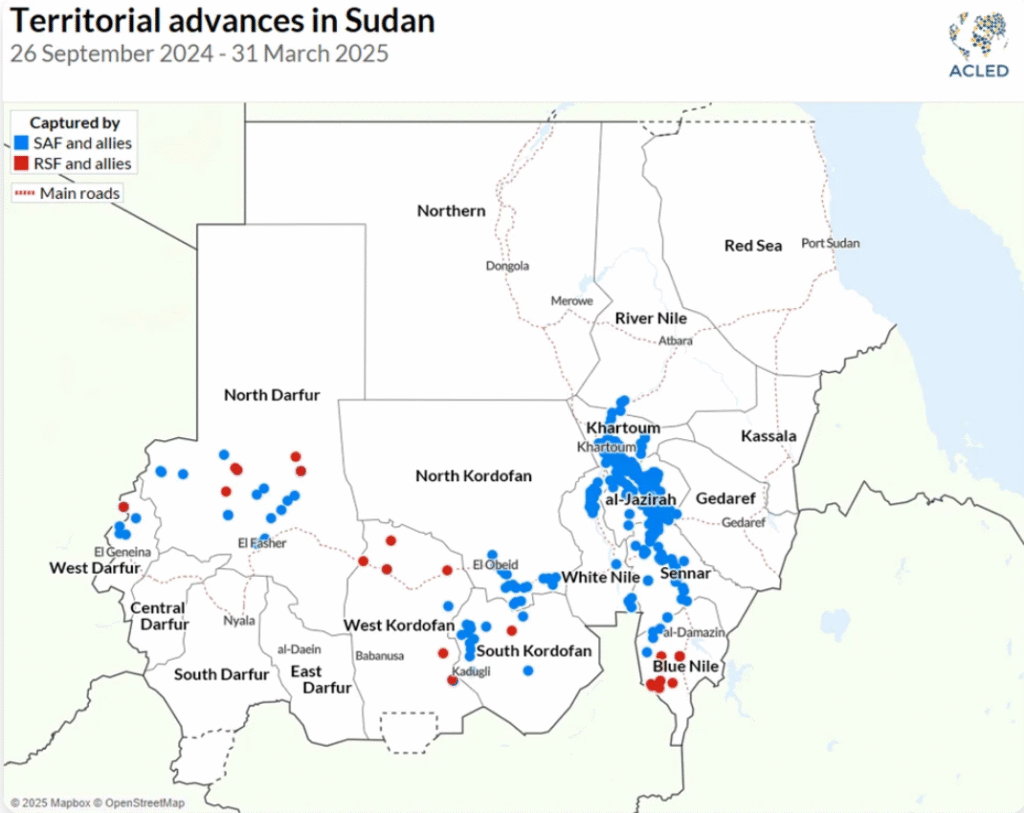
Map 1: Military distribution of the SAF and RSF in Sudan

Source:   Ali et al. 2025. Two years of war in Sudan: How the SAF is Gaining the Upper hand.

The political and security situation in Sudan is heavily influenced by the rise of armed militias, which could also impact neighboring countries. "Almost everyone wants/has them without realizing the potential consequences," which highlights the problem with militias. These groups' growth threatens peace and, in severe cases, may lead to Sudan splitting into smaller, conflicting factions. Consequently, a serious political crisis is unfolding amid the SAF's efforts to maintain its political gains, conflicts with the RSF, and a lack of security and government authority, along with the militias' political goals. As seen in Darfur, where the RSF is involved (such as conflicts between the Rizeigat and the Messiria over leadership and privilege), and among militias in Eastern Sudan, these groups have evolved or fractured into smaller, hostile, and rival factions across multiple states. Notably, the ongoing "War of Dignity" in Port Sudan, where the army leads the de facto government in a truce with Islamists (the dissolved National Congress Party), aims to eliminate the RSF. However, forces aligned with them—like the SAF and the DJF—have clashed over political influence and power-sharing (25% of the power-sharing agreement), a privilege granted under the Juba Agreement of 2020. This agreement is both outdated and illegitimate. Moreover, its underlying ambiguities and the illegitimacy stemming from the coup against the Transitional Civilian Government (TCG)—which led to it—have been overlooked. The signatory armed groups remain in power despite failing to meet the agreement's goals—peace, civilian governance, and military integration. This has led the Darfur movement to abandon neutrality and form an alliance with the SAF to share power instead of pursuing peace or civil transformation. They aim to gain from the "extinct" agreement by maintaining their current minister positions and creating new roles, such as “Vice President of the Sovereignty Council,” as well as other high-level government roles and contested issues between the DJF and SAF. Inter-tribal conflicts within regions or tribes themselves, combined with political ambitions, significantly drive the rise and spread of militias in Sudan, especially in the Red Sea state, where the Hadendowa and the Bani Amer compete for political influence. This reality has led to the formation of Bani Amer armed militias (for example, groups led by Amin Dawood and Ibrahim Dunya) and divisions within Beja's political and military groups, such as the Beja Congress - Unified Leadership, Mohamed Agdef - Tirk Alliance, and the Sheba Darar group. Additional factions have split from the Hadandawa’s traditional Nazir (chief)-Tirk, such as the Betai group, followed by the Samrar and Qorhab tribes, each claiming independence and establishing their chieftaincies. To shift the power struggle away from the two dominant groups—the Hadandawa and the Beni Amer—several ministers linked to other chieftaincies, like the Amar’ar and the Artega‘s independent chieftaincy, have been appointed. These recent appointments reflect ongoing political rivalries and efforts to balance power. For example, appointing the Interior Minister from the alqaryiyb tribe—a subdivision of the Hadandawa—and nominating Nawara Abu Mohammed, a woman from the Ashraf independent chieftaincy, to the Sovereignty Council highlight these shifts.

The troubling reality is that, as part of the brutal war against the RSF, these militias were formed along tribal lines and overseen by the army. Furthermore, in response to promises of incentives and political and economic dominance, both sides of the conflict have mobilized in opposing tribal and regional areas. All these groups and militias across the region lack a clear program or political vision to address the political crisis or regional issues (Alarab Newspaper, 2024, & Abdelfattah, 2025). As a result, they are already emerging as tools for political pressure and a way for local leaders to gain influence. From another perspective, it is believed that the army's goal is to threaten the joint forces allied with it, which are stationed in those states. It also works with local leaders to create armed militias, particularly in eastern Sudan (Al-Gadarif and Red Sea States, which have around 10,000 men). This is done by claiming it has military support in case they rebel or demand more political gains after their victory. Overall, the growth of these militias threatens Sudan's peace, unity, and stability. 

Furthermore, the ties between the army and the Islamic Movement regime prolong the war and hinder peace by obstructing all regional and international efforts to resolve the escalating crisis and restore power in Sudan. Another critical point is that the continuation and expansion of the war, combined with the vulnerability of the social fabric, allow local leaders and their militias to control this ethnic diversity. This is because the state is either unable or unwilling to enforce security and protect its citizens, leading Sudan to become divided into tribal cantons. The emergence and proliferation of militias supported by both parties to the conflict, especially the SAF, and the initial of offices for informal forces in cities and villages, as well as their presence among civilians, have led to a series of killings actions, human rights violations, and security troubles throughout Sudan, Despite the public's protests and calls for the government to withdraw these troops and end their mobilization and militarization in some regions. Both SAF & RSF and their allied militias have been accused of committing several cruelties.

Unlawful killings were carried out by the RSF and its allies, including mass executions, sexual assaults, attacks on civilian property, and frequent use of heavy explosives in populated areas. The SAF and its allies tortured detainees, mutilated bodies, committed acts of sexual violence and brutal executions, bombed populated areas without discrimination, and deliberately destroyed civilian infrastructure (The Human Rights Watch, 2025).  Several of these atrocities occurred in the states of West Darfur, West Kordofan, Al-Gazira, and Sennar. Additionally, media reports and eyewitnesses have reported that SAF-affiliated militias (e.g., Islamic groups, al-Bara’a Brigade, and Sudan Shield Forces) have been carrying out a vicious cycle of retaliation and continuous attacks on Kanabi people; in the case of "Kambo Taiba" in Um Al-Gurha, east of Al-Gazira, these militias have been accused of repeatedly attacking the village, killing 13 people, including two children, and arresting women and civilians in January 2025 ( the Human Rights Watch, 2025). As in the cases of Dinder in Sennar State, Al-Khoei in West Kordofan, and Al-Hamadi in South Kordofan, these are recurrent attacks that occur whenever the RSF withdraws from areas under control, and the army moves in.

 Hundreds of people in southern Sennar have reportedly been killed by the SAF and its affiliated militias, who were perceived as "collaborators" and social supporters of the Rapid Support Forces. During strict secrecy and a total communication blackout in the area, a witness claimed that the Sudanese army carried out gruesome massacres south of the state of Sennar, killing hundreds of civilians and imprisoning dozens while claiming to be working with the "RSF" and being tribal supporters of the Darfur tribes in western Sudan in the towns of Dinder and Suki. (Asia News, 2024). At the same time, there was a massive arrest campaign that targeted civil society activists and politicians in the eastern and southeastern states of the country, particularly in the cities of Sinja, Al-Gadarif, and Al-Fao (Asia News, 2024). Witnesses in Sennar state claim that the SPLA-N Agar faction has engaged in excessive violence against civilians, threatening and intimidating them, and stealing their property and possessions while threatening to use force, as is evident in most parts of Sennar city. The Al-Bara'a Brigade, meanwhile, stepped up its targeted arrests of civil activists and politicians as well as its house raids.

Map 2: Kambo Tayba (Umm al-Qura Locality, Al-Gezira State)

Source: The Human Rights Watch 2025.

The main point here is the risk of tribal –based conflicts between militias in states with different ethnic groups, such as in eastern Sudan (Al-Gadarif and the Red Sea) and Al-Gezira. Signs of tension and conflict based on tribal and regional differences have emerged, as seen in Al-Gezira State, where clashes occurred between the joint forces and the Sudan Shield Forces after accusations against the Sudan Shield Forces of violating residents of Al-Kanabi, most of whom are from western Sudan (Darfur), during operations to regain control of Al-Gezira State. There are also differences regarding how these forces are present, active, and coordinated in the state (including the Joint Forces, Sudan Shield, and Al-Bara’a Brigade). As a result, distinct tribal alliances have emerged, particularly as these forces' members and military commanders have been integrated.  Additionally, observers and witnesses stated that the state was split up into spheres of influence according to the militia's tribal affiliation or its control over designated areas. Numerous offices, inspection points, and checkpoints were established with militia affiliations. The Joint Forces and the Sudan Shield Forces, which control all of East and North Al-Gezira, have established themselves close to the Kanabi districts and the residential areas of West Sudanese tribes in cities and villages, especially in the central and western locations. The state capital of Madani has turned into a gathering place for all the state's militias and armed units, as well as their headquarters, while the Al-Bara'a faction has set up an office in the Arbji neighborhood adjacent to Al-Hasaheesa.

 Given the disruption of the peaceful political process, growing societal division, and bloody path to political influence and dominance, the demands of the militias may go beyond obtaining political and executive positions to include demands for self-determination or secession from their region if the SAF is unable to control them. The army leadership and its alliance with the Islamists (the dissolved National Congress Party) and the opportunistic military groups that were granted military, political, and financial privileges to shape, lead politics, and obstruct a path towards democratic transformation and civil governance in Sudan are undoubtedly primarily responsible.

In summary, the emergence and growth of tribal, regional, and other militia groups in transitional Sudan has raised security concerns and threatened state unity as well as political stability. These can be summed up as follows:

  • State fragility, illegitimate governance, and the rise of militias—especially those motivated by ideology and tribalism—have the potential to produce barrel armies in Sudan that threaten the legitimacy, power, and security capabilities of the government. In addition to severely fragmenting the government, this may lead to a breakdown in social, political, and military cohesion.
  • Experience to date shows that the existence of tribal militias has led to crimes and violations of human rights, such as rape, torture, killing, and displacement. Their behavior has the potential to incite animosity, split societies, and further erode social integration and cohesion.
  • Establishing capable and responsible security forces is impossible in Sudan's current situation due to the proliferation of numerous militias with varying origins and political objectives. However, it is a complex and often challenging process to disarm and reintegrate militias into the state's security apparatus.
  • The growth and proliferation of militias in Sudan can cause instability and conflict in the region by spreading to unstable neighboring countries (e.g., Chad, Central Africa, South Sudan, Eritrea, and Libya).
  • Because they can gain access to resources or political power, militaries may be motivated to hinder peace efforts and prolong hostilities.

Concluding Account: Alleviating Militia Crisis and Peace Possibilities in Sudan: Way Ahead

Authoritarian regimes, ongoing interstate conflicts, or fragility can all lead to the formation of militias. This is clear in countries like Somalia, Yemen, Libya, and Iraq, where political unrest has caused the state to fall apart, become weaker, or split under the influence of militias. In every instance, the emergence of militias threatens national security and thwarts attempts to establish stable regimes in already unstable nations. Sudan is an exception. Originally established by successive central governments, militias grew under Bashir's dictatorship, which lasted from 2003 until his overthrow in 2019, primarily to defend his corrupt governance. However, during the ongoing war, militias have spread across Sudan and continue to grow. Evidence suggests that their main goal in helping establish militias is political—everyone seeks political and economic gains and aims to secure the SAF's political influence gained during the war. Nonetheless, the outcomes may be different from expected. The presence of multiple, competing armies in a weakened state increases political rivalry, complicates peace efforts, and may lead to heightened demands for referendums, including secession, by warring factions and their allies.

From groups supporting the SAF or leading rebellions against the ruling authority (e.g., RSF) to becoming a growing security and political threat, militias have essentially evolved into a significant influence in Sudan's political scene over the decades, beginning with the start of the second civil war in the 1980s. The ongoing war, combined with ambitions for power, political influence, and financial gain, has led to the expansion and spread of militias in Sudan, which continues today. Since their emergence, militias affiliated with both the SAF and RSF have committed numerous violations, including crimes against humanity, causing the largest humanitarian crisis in recent history. Their desire for conflict is clear in their pursuit of influence and power as a reward for supporting the SAF. Amid the state's weakness, government illegitimacy, security lapses, and the SAF's backing of militias to fight the RSF and other armed groups in case of mutiny or disagreement, the ethnic backgrounds of the militias and the diverse society they represent add to conflict and instability.

Besides weakening state authority, this can lead to the rise of tribal areas and conflicts among warlords over land, wealth, and power, which further threaten the country's security and unity. Disbanding these groups or integrating them into a national military through an inclusive, peaceful, and democratic process that addresses the root causes of political, economic, and social issues is essential for lasting peace and resolving the militia problem. Moreover, while regional and international support is urgently needed, only sustainable peace can effectively resolve the militia issue and promote unity, security, and peace in Sudan.

Reference:

  1. Onamu, B and Nyadera, I. 2024. Paramilitary Forces, Domestic Politics and Conflict: A Case of the Sudan Crisis.  Obrana a Strategie; Brno, Vol. 2024, Issue (1): 143-158.
  2. Konečná, L. 2024. Recent Trends in Pro-Government Militias in Africa: A Useful Tool or a Threat?. Asian Journal of Peacebuilding, Vol. 12 No. (2): 257-278.
  3. Felbab-Brown, F. 2020. “The Problem with Militias in Somalia: Almost everyone wants them despite their dangers”. In Adam Day (ed), Hybrid Conflict, Hybrid Peace:  How militias and paramilitary groups shape post-conflict transitions, pp. 113-156. New York: United Nations University, Centre for Policy Research.
  4. The Africa Center for Strategic Studies.  2021. Party Militias — A Threat to Security and Military Professionalism. Washington, DC: The Africa Center for Strategic Studies.
  5. Tsega, B.  2021. Regional Special Forces Pose Threat to Peace and Security in Ethiopia. https://theglobalobservatory.org.
  6. Dahia, A. 2005.  The humanitarian situation in Darfur: Armed conflict. https://www.ssrcaw.org/ 3/5/2005.
  7. The Small Arms Survey. 2027. Issue brief. Remote-control breakdown of Sudanese paramilitary forces and pro-government militias. Geneva: The Small Arms Survey.
  8. The Global Witness. 2019. “Secret documents reveal financial network supporting Sudan’s most powerful militia - responsible for the Khartoum massacre”. https://globalwitness.org/ 09 December 2019.
  9. Donare. 2025. Humanitarian News.  “Sudan: WFP reaches people facing or at risk of famine”. https://donare.info/en/news. 
  10.  Al-Nur. S. 2024.  “Sudan: How War Generated New Dorm of Militias”. https:// assafirarbi.com/12/12/2024.
  11. Ali, A; Birru, J and Eltayeb, N. 2025. Two years of war in Sudan: How the SAF is Gaining the Upper Hand.  Madison, Wisconsin: Armed Conflict Location and Event Data ACLED.
  12. Sky News. 2023. “92 groups. Where do the armed movements stand on the Sudan war?”.  https://www.skynewsarabia.com/middle-east, December 24/2023.
  13. Ali, A. 2025. “The rise of armed groups in eastern Sudan: causes and consequences”. https://studies.aljazeera.net/ar/ 19/1/2025.
  14. Aalrab Newspaper. 2024.  The rise of armed groups increases the danger to Sudan's future.  https://www.alarab.co.uk/2024/28/2024. 
  15.  Abdelfattah, M. 2025. “Does the army, tribes, and militias ally to govern Sudan?”. https://www.independentarabia.com, June / 14/ 2025.
  16. The Human Rights Watch. 2025. “Sudan: Armed Group Allied to the Military Attacks Village: Hold Forces Accountable for Gezira Attacks; Protect Civilians”. https://www.hrw.org/news/2025/02/25.
  17. Asia News. 2024. “Sudan: A wide-ranging campaign of arrests targeting political activists and their family members”.  https://www.asianewslb.com/ 8/4/2024.