
Sudan's war has stopped being a duel between two generals. In Gezira, it has become a quarrel over cotton, canals, and the right to tax a road — and no ceasefire signed abroad will settle it.
Sudan Scope | Editorial
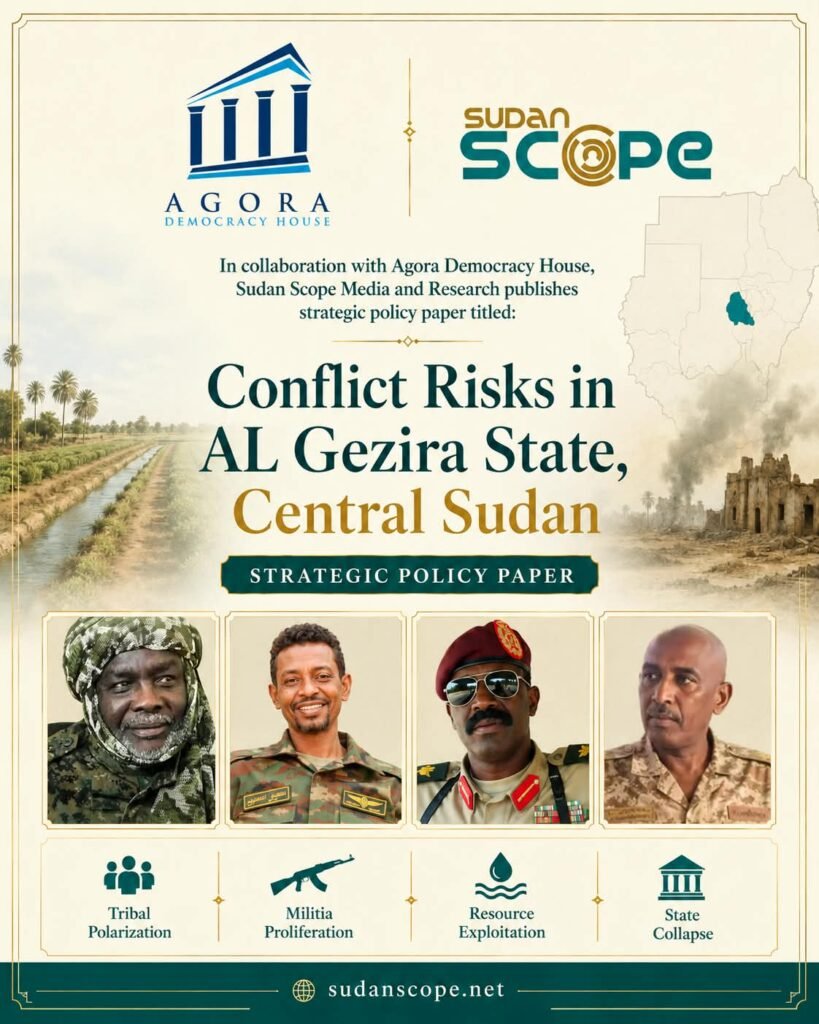
In partnership with Agora Democracy House. Based on the joint policy brief "Escalating Community Mobilization, Politicization, and Conflict Risks in Al-Gezira State," research supervised by Dr. Elnazeer Mohamed Shaaeldin.
The canals were dug to carry water. Four thousand three hundred kilometers of them, cut into the clay between the Blue and White Niles from 1925 onward, feeding 2.1 million feddans by gravity alone. Every Sudanese schoolchild once learned the arithmetic of it: the Scheme paid for the ministries, the railway, the scholarships abroad. Our grandfathers described their lives in the vocabulary of the tenancy, the Hawasha, the block inspector, the cotton grade, the year the water came late.
In early 2025, after the army retook Wad Madani, investigators pulled a different cargo out of those canals. CNN and Lighthouse Reports documented bodies in the irrigation channels and in mass graves around the city, many bearing the marks of execution. The waterways were not an accident of geography. They were a method.
That inversion is the story of Gezira, and it is not a metaphor. Infrastructure built to force strangers into cooperation is now being used to enforce a hierarchy of who belongs. And while the world's envoys argue in Cairo, Berlin and Washington over which army withdraws from which city first, a quieter question is being settled on the ground, block by block, before the next harvest: who owns the Scheme?
The binary is already dead
The war is still narrated abroad as a duel, the Sudanese Armed Forces against the Rapid Support Forces, Port Sudan against Nyala, one general against his former deputy. In Gezira, that frame has not described reality for some time.
Field survey work and key informant interviews conducted across the state this year map a landscape that no binary can hold. The Sudan Shield Forces, rooted in the Shukriya communities of the Butana and estimated at anywhere between 35,000 and 75,000 fighters. Splinters of the Justice and Equality Movement, a Darfuri movement now administering offices in Rufa'a and Hasahisa, hundreds of miles from the war it was born in. The Al-Baraa ibn Malik Brigade and the Islamist Operations Authority, which answer to a movement, not a constitution. The Sudanese Alliance Forces. The Gezira Liberation Movement. Tribal formations in Manaqil bearing the names of companions of the Prophet. Popular Resistance units that have taken over administration in Al-Huda outright. Even Tigrayan fighters, passing through on someone else's war.
These groups are routinely described as auxiliaries. They are not. The defining shift of the past two years is that they have stopped needing their patrons. A faction that can liquidate a silo of stored sorghum, tax a lorry at a checkpoint, take a percentage of a market's fees and lease out a ginning mill does not require a monthly envelope from Port Sudan. Financial self-sufficiency is political independence. It converts a proxy into a competitor.
Abu Aqla Kaikal is the clearest case, and the most instructive. He fought for the army, defected to the RSF, took part in the fall of Wad Madani, then returned to the army in October 2024 when the wind changed. The RSF punished the communities it associated with him with mass atrocity. His own forces, in turn, were credibly accused of massacring civilians at Tayba in January 2025; Human Rights Watch counted at least 26 dead, houses burned, property looted. The European Union sanctioned him in July 2025. And in April 2026 he arrived in Blue Nile at the head of his men, vowing to clear the state of the RSF.
Sanctions did not remove him from the field. They gave him a new front.
Three futures, all happening at once
Our researchers tested the state's trajectory against three scenarios. The uncomfortable finding is that these are not alternatives. All three are running simultaneously, and they reinforce one another.
The first is fragmentation. Where there is no genuine unity of command — only a protocol asserting one — sub-commanders discover they have more to gain from a village than from a chain of command. Loyalty is priced locally. Alliances hold for a season.
The second is the cartel, and it is the most entrenched. In the calmer districts, armed groups have not seized the administration; they have joined it. They sit on crop-marketing boards and irrigation committees. They share checkpoints with what remains of the police. They issue commercial permits and powers of attorney, grant fee exemptions, take a fixed cut of market taxes and zakat, and levy "security contributions" on families living off remittances. Racketeering here does not look like banditry. It looks like paperwork. That is precisely what makes it durable: it survives ceasefires, because on paper it was never war.
The third is the one that will outlast the fighting. Across eastern Gezira, Hasahisa and Umm al-Qura, the collapse of tenancy law has allowed militias to reopen a century-old question of belonging. The Kanabi — the labour camps whose residents descend from Darfuri, Kordofani and West African families brought to work this land generations ago — have been collectively accused of collaboration and treated accordingly. Camps burned. Families displaced. Agricultural land quietly retitled, converted to residential plots, and sold.
That last detail deserves more alarm than it gets. Killing empties a village. A land registry keeps it empty. When a tenancy is cancelled and re-issued, displacement acquires a document, and the document will still be there when the guns are quiet and the courts reopen. Sudan has seen this sequence before, in Darfur. We appear determined to learn nothing from it.
Why the truce will not reach Wad Madani
As of this month, the American-brokered push for a 90-day humanitarian truce is stalled. The army demands the RSF withdraw from the cities it holds; the RSF calls that surrender. The mediators will keep working, and they should.
But consider what a signature would actually bind. It would bind two belligerents. It would not bind the Shield Forces, the Baraa brigades, JEM's splinters, or a village committee in Manaqil that controls a canal gate. None of them are at the table. None of them would be required to give up a checkpoint, return a silo, or restore a tenancy. For them, a truce is not a constraint. It is a licence to convert wartime possession into peacetime title, with the international community's blessing and nobody counting.
This is the flaw running through three years of Sudan diplomacy: it treats the war as a disagreement between two men, when the war has already devolved into an economy. You cannot end an economy by asking it to stop shooting.
What would actually help
Four measures, none of them requiring the generals' consent, all of them urgent before the next harvest cycle turns possession into ownership:
Freeze the land registry. An immediate, publicly declared moratorium on every transfer, reallocation or cancellation of agricultural tenancy in the Scheme for the duration of the conflict, with a commitment from donors and any future authority that transactions made under arms will not be recognised. This costs nothing and closes the door that ethnic engineering walks through.
Shield and audit the assets. The ginning mills, the silos, the pumping stations and the heavy machinery are the material base of the cartel. An independent civilian-international board should audit the Scheme's revenues and asset register, and pilot digital, decentralised crop purchasing that pays farmers without their produce ever passing a checkpoint. Take the tollbooth out of the supply chain and much of the militia balance sheet goes with it.
Make integration conditional, and sanction downward. Amnesty and absorption into state structures should be available only against verifiable command unification. And sanctions must stop stopping at the famous names. It is the mid-level field commander who orders the raid, sells the crop and signs the permit. Travel bans and asset freezes at that tier would change behaviour in a way that designating one warlord, who then redeploys to Blue Nile, plainly does not.
Protect the Kanabi, and revive the ajaweed. A dedicated human rights observation mandate inside the camps, and real support for the traditional cross-communal arbitration committees that settled boundary and water disputes in this state for a century — kept firmly out of the hands of the Popular Resistance committees that have replaced them.
The thing worth saving
There is a temptation, when writing about Sudan, to reach for the language of collapse and leave it there. We should resist it here, because Gezira's history contains an argument.
For nearly a hundred years this state was the one place in Sudan where the identity wars did not take. Not because its people were more virtuous, but because the Scheme made them dependent on one another. Water shared down a single canal, a crop that needed many hands, a dispute system that had to work because the alternative was that nobody ate. Riverine tenant and Kanabi labourer, Shukri and Zaghawi and Fur, tied together by an irrigation ditch. Coexistence was not sentiment. It was infrastructure.
That is what is being dismantled, and it will not be rebuilt by a communiqué. It is being replaced by something with an office, a stamp, a fee schedule and a militia, a set of local authorities that no one voted for and that no peace agreement currently contemplates disarming.
The canals are still there. The soil is still there. Farmers went back to Roweina and to a hundred villages like it and put seed in the ground, which is the most stubborn act of political optimism available to a Sudanese right now.
The question this year is not whether Gezira will produce a harvest. It is who will be standing at the gate when it does.



