
Executive Summary
Context & Problem Statement
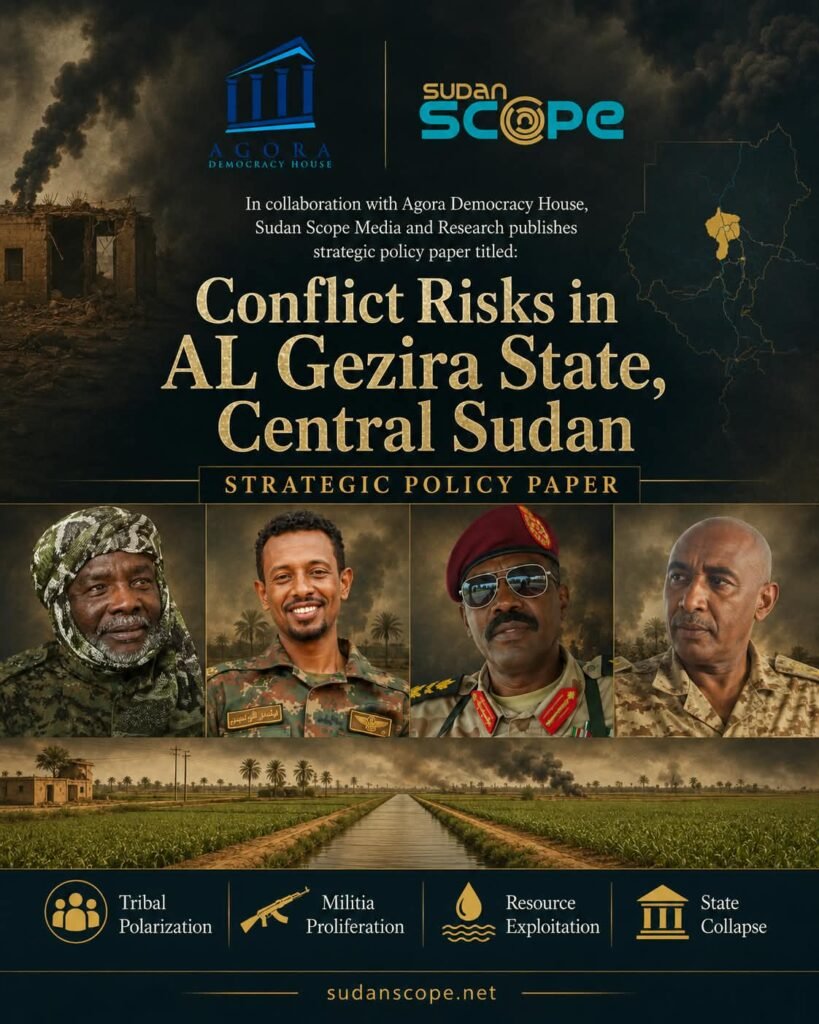
Al-Gezira State, traditionally the peaceful agrarian heartland and economic engine of Sudan, is rapidly descending into systemic instability. Following the macro-level warfare between the Sudanese Armed Forces (SAF) and the Rapid Support Forces (RSF), the region has seen a dangerous proliferation of non-state armed actors. These include the Sudan Shield Forces (SSF), Islamist brigades (e.g., Al-Baraa Ibn Malik), tribal formations, and splinters of the Justice and Equality Movement (JEM). Rather than acting as mere extensions of national coalitions, these factions are exploiting the structural collapse of the state and its 2.1-million-feddan Gezira Agricultural Scheme to pursue independent, self-serving political and economic agendas.
Analytical Approach: Addressing the Three Gaps
Conventional macro-political analyses routinely overlook the ground-level drivers of Sudan's fragmentation. To provide an accurate diagnosis, this brief utilizes a localized, empirical mixed-methods framework—triangulating key informant interviews (KIIs) and field survey data—built around three critical analytical vectors:
- The Militia Re-Makeup: Tracking the evolution of armed groups from dependent state proxies into autonomous, sovereign competitors.
- The Hybrid Security Ecosystem: Mapping the heavily blurred boundaries where formal state administrative remnants and informal security actors intersect and collude.
- Micro-Political Dynamics: Isolating granular, village-level resource conflicts rather than relying solely on broad national political narratives.
Key Findings & Evaluated Scenarios
The triangulation of field data reveals that the Gezira Scheme has mutated from an agrarian asset into a critical resource trap, actively fueling three simultaneous conflict trajectories:
Scenario 1: The Fragmentation Trap (High Probability / Current Baseline):
Erratic structural mutations, opportunistic defections, and horizontal rivalries—most notably involving the SSF—are triggering localized command splintering. Factions break away from national proxy networks to claim independent territorial control over micro-geographic footprints.
Scenario 2: The Warlord Cartel (Entrenched Reality):
In relatively secure zones, SSF, JEM, and Islamist factions are institutionalizing their presence within a corrupt hybrid security space. By co-opting municipal crop-marketing boards, extracting percentages of market fees and taxation, and seizing agricultural yields, they turn war profiteering into a pseudo-legal administrative function. This exploitation relies heavily on official institutional facilitation, including the illicit issuance of commercial permits and powers of attorney, government fee exemptions, smuggling networks, and the extortion of remittances from citizens.
Scenario 3: Tribalized Polarization (Critical Risk Trajectory):
The collapse of formal agricultural tenancy laws, illegal land-sizing, and rising ethnic enmity have allowed militias to weaponize historic land tenure and residency grievances. By backing riverine groups against communities originating from western Sudan and orchestrating forcible displacement, militias are driving the state toward existential ethnic polarization, specifically targeting marginalized Kanabi settlements.
Strategic Recommendations
Top-down diplomatic settlements between macro-belligerents will fail to stabilize Central Sudan if the material incentives driving local militias are left intact.
This policy brief proposes a targeted, three-tiered intervention strategy:
- Dismantle the Cartel Economy: Establish an independent international asset-shielding board to audit and protect the Gezira Scheme's industrial infrastructure (ginning mills and silos). Bypass physical checkpoint extortion by implementing decentralized, digital supply chains managed by neutral, civilian-led local councils.
- Enforce Command Accountability: Condition any future security sector integration on verifiable command unification. Enforce targeted mid-level multilateral sanctions against field commanders orchestrating localized splintering and racketeering.
- Stabilize Local Land Tenure: Issue an immediate administrative moratorium on all land title alterations within the Gezira Scheme to prevent militias from engineering demographic shifts. Revitalize traditional cross-communal arbitration committees (Ajaweed) and deploy targeted human rights observation mandates to protect vulnerable Kanabi communities.



