Dr. Mohammed Siddiq
The Decline of Democracy
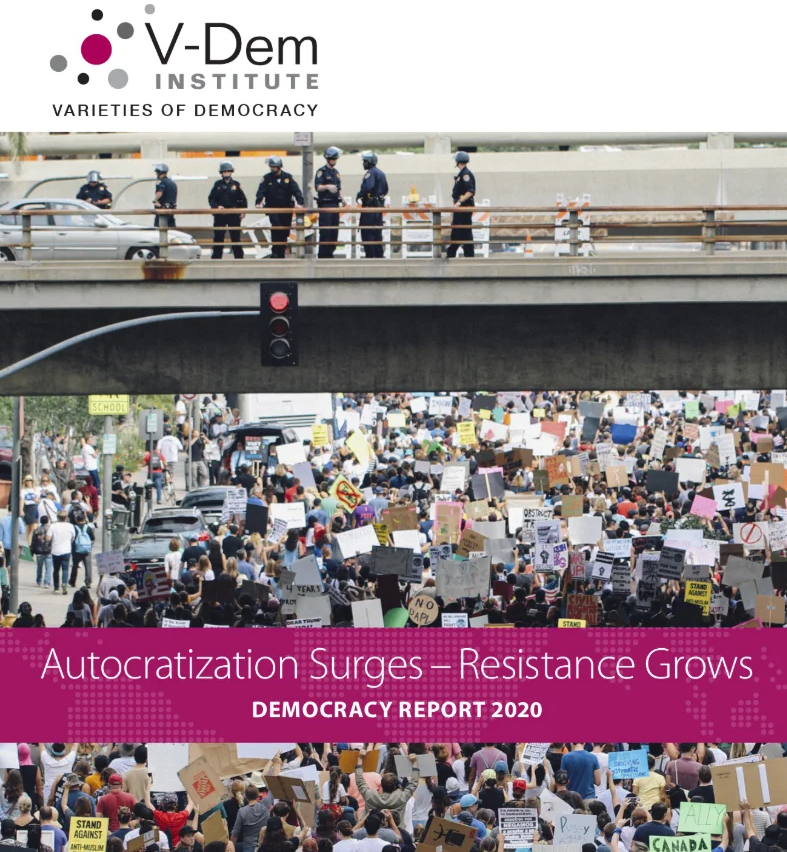
In a world moving rapidly toward political instability and the erosion of democratic values, the Global Democracy Report issued by the V-Dem Institute (Varieties of Democracy) gains exceptional importance, not merely as a measurement tool, but as a precise mirror reflecting deep transformations in the structure of governance around the world.
Founded in 2014 and headquartered at the University of Gothenburg in Sweden, the institute is built upon a core philosophy: democracy is not a single concept reducible to elections alone; rather, it is a complex, multidimensional phenomenon. Based on this principle, it developed a unique methodology that measures more than 600 different characteristics of democracy through assessments from local experts within each country, providing significant analytical depth and qualitative accuracy.
The report’s database relies on more than 32 million data points covering 202 countries and territories, extending from 1789 through 2025, making it one of the largest research projects on the evolution of political systems in modern history.
Definitions of Democracy’s Components
V-Dem evaluates democracy through five interconnected dimensions:
Electoral Democracy: The fundamental core of any democratic system. It includes free, fair, and recurring elections, universal suffrage, genuine multiparty competition, and guarantees of freedom of expression and media.
Liberal Democracy: Builds upon electoral democracy by adding civil liberties, rule of law, and checks and balances. Elections alone are insufficient unless elected leaders are effectively constrained by legislative and judicial institutions, while individual rights remain protected, even against the majority.
Egalitarian Democracy: Based on the principle that political rights and freedoms should be distributed equally across society. Rights should not merely exist theoretically but be genuinely accessible regardless of gender, race, class, or wealth. This dimension measures equality in legal protection, access to power, and distribution of resources enabling political participation.
Participatory Democracy: Goes beyond periodic voting by ensuring citizens are actively and continuously engaged in political life through civil society organizations, mechanisms of direct democracy such as referendums, and participation in local and regional governance. Effective democracy requires citizens who engage daily, not merely seasonal voters.
Deliberative Democracy: Focuses on the quality of public debate and decision-making, ensuring policies are based on rational arguments and collective discussion rather than coercion, narrow interests, or emotional manipulation. It measures governments’ commitment to justifying decisions in terms of public interest, respecting opposing views, and consulting civil society.
The Global Picture in 2025
The report reveals a troubling historic decline: global democracy has returned to levels last seen in 1978, suggesting that the gains of the “third wave of democratization,” which began in Portugal in 1974, have largely eroded.
According to the report, 74% of the world’s population, approximately 6 billion people, now live under authoritarian systems, while only 7% (around 600 million people) enjoy liberal democracy. For the second consecutive year, the number of authoritarian regimes (92 countries) exceeds the number of democracies (87 countries).
Three major patterns emerge: democratic decline within countries with established democratic traditions; the collapse of recent democratic transition experiments; and the deepening of authoritarianism in already authoritarian systems. More concerning still, this third authoritarian wave exceeds, in scale, depth, and duration, the wave of the 1930s that preceded World War II.
Countries Leading Democracy Rankings
Northern and Western European countries dominate global democracy rankings. Denmark ranks first with a score of 0.88, followed by Sweden (0.85), Norway (0.85), and Switzerland. The Baltic states also perform strongly.
In the Pacific region, Australia, New Zealand, and Japan lead. In Latin America, Costa Rica (7th globally) and Uruguay (13th) stand out, alongside Brazil (28th), which is gradually recovering. In Africa, Seychelles remains the only liberal democracy in Sub-Saharan Africa.
The United States: The Fall of Symbols — From the Top to Rank 51
The trajectory of the United States over the last decade can be divided into four phases:
Phase One: Stability (2015–2016)
The U.S. ranked among the world’s top twenty countries and was classified as a strong liberal democracy. Deliberative and participatory indicators remained high, while checks and balances functioned effectively.
Phase Two: Beginning of Decline (2017–2020)
During Donald Trump’s first administration, the score dropped from 0.85 to 0.73, a decline of approximately 14% within four years, returning the country to levels seen in 1976. Major indicators included pressure on media, questioning election legitimacy, and targeting opposition groups.
Phase Three: Partial Recovery (2021–2023)
Under Joe Biden, the score recovered to around 0.79 but did not return to pre-2016 levels. Polarization remained severe, and the report described the country as remaining on a “dangerous slope.”
Phase Four: Major Collapse (2024–2025)
During Trump’s second administration, the score sharply declined from 0.79 to 0.57 in only two years, the largest democratic decline in U.S. history since 1789. The country dropped from rank 20 to rank 51 and lost its classification as a liberal democracy, becoming merely an electoral democracy.
Several indicators deteriorated significantly, including legislative constraints reaching their lowest levels in over a century, Congress losing oversight effectiveness, declining freedom of expression and media, civil rights falling to levels comparable to the 1960s, and visible erosion in judicial independence.
Britain: Quiet Erosion at the Heart of Liberal Democracy
Britain’s path differs from the American experience in form but converges in direction. Between 2015 and 2019, the UK remained among the world’s top twenty democracies with a relatively strong liberal democracy score.
However, the contentious debate surrounding Brexit gradually affected the quality of public discourse, particularly deliberative democracy indicators.
By 2020, V-Dem observed the beginning of formal regression, with declining media freedom and increasing self-censorship within media institutions. Between 2023 and 2025, the decline expanded further, including notable reductions in academic and cultural freedom.
The essential distinction between the American and British experiences lies in the nature of the decline: the American path is marked by confrontation driven from political leadership, while Britain’s decline resembles a gradual, institution-wide process of quiet erosion.
Sudan: From a Glimmer of Hope to the Bottom of the List
While democratic decline in advanced democracies is concerning, Sudan represents perhaps the most tragic case in a broader global context.
In the 2020 report, Sudan was listed among countries representing “glimmers of hope.” Citizens’ mass protests had been recognized as genuine democratic breakthroughs. Yet the trajectory dramatically reversed.
From 2015–2017, Sudan remained near the bottom of global rankings under an entrenched authoritarian regime dominated by the National Congress Party and Islamist movement, accompanied by repression and economic crisis.
In 2018, mass protests emerged, culminating in the overthrow of the regime in 2019, a historical turning point that briefly shifted Sudan into a transitional category and opened a window for democratic reconstruction.
However, the transition was fragile. Civil-military tensions prevented structural reform and political stability. This institutional weakness paved the way for the October 2021 coup, which effectively ended the democratic experiment.
Between 2022 and 2023, political deadlock deepened, repression intensified, and by April 2023, war erupted, triggering a total state collapse.
Sudan subsequently dropped to unprecedented rankings between approximately 170–173 in 2024–2025, amid ongoing conflict, institutional breakdown, and widespread collapse.
Sudan’s story therefore reflects an incomplete democratic transition cycle: from entrenched authoritarianism, to promising revolution, to fragile transition, to military reversal, and ultimately to catastrophic collapse.
Why Is This Report Dangerous?
The danger of the 2026 Global Democracy Report lies not merely in documenting democratic decline, but in revealing a deep structural transformation in the global political order.
First, democratic decline is no longer confined to fragile states. When countries such as the United States lose substantial democratic capital, it weakens the global democratic model and indirectly legitimizes authoritarian alternatives.
Second, the report highlights the normalization of authoritarianism. Authoritarian practices are no longer treated as exceptional but increasingly presented as stable and effective models, especially as repression becomes less costly and international accountability weakens.
Third, democracy is increasingly eroded from within. Democratic backsliding now occurs not through traditional coups but through legal and institutional tools that preserve democracy’s outward form while emptying it of substance.
Finally, the report captures a moment where multiple crises intersect: wars, domestic polarization, economic instability, and the rise of global populism. Under such conditions, democracy becomes increasingly fragile and easier to lose.
The report’s central message is not simply that democracy is declining; it is that democracy itself faces an existential test.
The most important lesson is that democracy is rarely lost suddenly; it erodes gradually. Yet once it collapses, rebuilding it becomes a difficult, lengthy, and costly undertaking.
Democracy cannot be restored through slogans. It requires rebuilding systems of accountability and institutions on effective foundations.
Sudan represents the most extreme expression of this trajectory, where decline turns into complete collapse, making any democratic horizon impossible unless violence is broken, monopolies of force are dismantled, and the state is reclaimed under fully civilian authority.
Sudan therefore does not stand outside the global trend; it reveals its extreme limits. Democracy, when emptied of substance, collapses gradually; when seized by force, it collapses suddenly. In both cases, restoring it is costly and profoundly difficult.



