
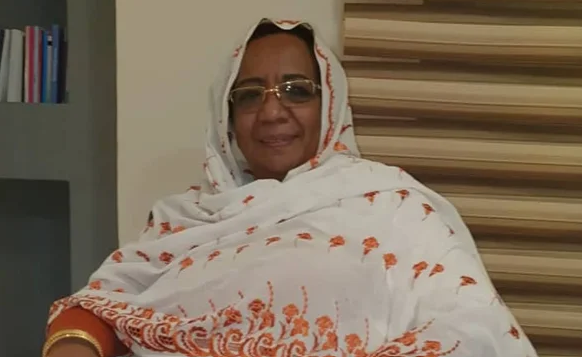
Exclusive Interview- Sudan Scope
Today, the “Sudan Scope” platform hosts a prominent academic figure and committed human rights activist, Professor Zuhal Mohamed Al-Amin, Professor of Constitutional and International Law at Al-Zaeem Al-Azhari University. She holds two doctorates in Constitutional Law and International Law and Human Rights. She has been trained at the world’s most prestigious institutions in the fields of human rights, international humanitarian law, peace studies, arbitration, and mediation. Professor Zuhal is known for her active role in human rights and civil society. She is a member of the Sudanese Observatory for Human Rights and the Arab Organization for Constitutional Law. She has participated in important campaigns such as “Women Against Injustice” and “Together to Combat Rape and Sexual Violence. She has authored numerous books and published scientific papers. She served as an expert in drafting the 2022 Transitional Constitution and the Women’s Agenda in the upcoming constitution, in addition to her contributions to numerous legislations and peace agreements. We are pleased to have her with us today to discuss issues of utmost importance related to Sudan’s future and the role of women in it.
First, what were the challenges faced by women when the war broke out?
When the war broke out in 2023, women faced numerous challenges for various reasons. First, the war was sudden, and there was no expectation that the tensions would lead to a full-scale war, nor any anticipation of the severe violations that would particularly affect women. The greatest burden of the war fell on women working in the informal sector, most of whom are the sole providers for their families and children. After the war started, life came to a complete halt, especially in Khartoum, and the consequences of the war quickly became evident for this group. Even worse, women’s bodies were used as one of the tools of this war. Women were subjected to brutal rape, forced pregnancy, forced displacement, blackmail, and exploitation in labor (washing, cooking, and cleaning for soldiers, in addition to rape). The absence of law enforcement agencies enabled the perpetrators of violations against women to continue unchecked. Women had no social or family refuge, as fathers and sons were killed or threatened with weapons. Many women faced sexual violence in exchange for providing food for their families. All of this was made possible by the absence of legal, judicial, and security protection, exposing women to economic and sexual exploitation. The consequences of these violations remain evident in Sudan to this day.
To what extent has the women’s movement succeeded in expressing women’s issues in this war?
With the beginning of the war and the start of violations, a very strong women’s movement emerged. At the local community level, civil society organizations quickly moved to confront these challenges and violations by providing safe shelters for survivors, offering medical protocols to protect against sexually transmitted diseases and forced pregnancy, providing psychological support to survivors (despite its limitations during the war), and monitoring and documenting violations. At the regional and international levels, civil society organizations, self-initiated efforts, and feminist initiatives worked to monitor and record violations and transfer survivors to safe areas. This was accompanied by social, economic, and political complications in a conservative society. The women’s movement played a major role in highlighting these violations and exposing the perpetrators so they could not escape accountability at both the national and international levels.
What is your vision for the level of effectiveness of Sudanese women’s participation in shaping Sudan’s future? The participation of Sudanese women in shaping Sudan’s future is an issue of utmost importance and is fundamental. Women form an authentic and large part of society, not only in terms of population percentage, but also due to their pivotal role across different eras in shaping policies. This role is not limited to the political level but extends to building social customs and traditions that give rise to societies based on certain foundations. The Sudanese woman has always been an integral part of this formation. As I mentioned earlier, the Sudanese woman often bears the economic burden of the family, whether through work in agriculture, government and civil sectors, or even marginal professions. This aspect, for me, represents a basic component in shaping the political economy, reflecting the extent of women’s contribution to the country’s future economy. The Sudanese woman has also participated effectively since the post-independence era and was the first Arab female parliamentarian, indicating early women’s awareness. Women’s education began early, even outside the capital, leading to the spread of awareness among women in various regions. Even if we do not measure this at the academic education level, we can measure it by their contribution to building communities. Therefore, Sudanese women can play a very significant role in policy formulation and in state institutions that contribute to building Sudan’s future. However, there has always been a shortfall, whether at the social level due to the nature and composition of society that may reject women’s leadership, at the legislative level, or even at the ideological level. An ideology prevailed that considered the presence of a woman as a leader, president, or imam unacceptable in leading societies. Sometimes this issue has social rather than religious roots, but it is framed religiously to deprive women of their rights. This issue requires serious effort to confront so that women can have a greater role in shaping Sudan’s future.
Regarding the issue of rape, which has been strongly raised in this war, how can justice be achieved given the cultural privacy with which Sudanese communities deal with this type of issue?
The issues of rape and sexual violence have emerged strongly during this war, constituting violent violations against women. This was not a secret matter but was widespread in areas where the Rapid Support Forces were present. Rape is a criminal offense punishable by law, whether under Sudanese criminal law or any other law in the world. Perpetrators can even be referred to international criminal justice, as rape can be used as a weapon of war to humiliate women or as a tool of genocide to change the demographic features of certain communities. Therefore, rape is a crime that deserves the harshest punishments. Cultural Privacy and Challenges in Dealing with Victims
However, as you mentioned regarding the cultural privacy with which Sudanese communities deal with this type of issue, there is indeed a societal problem. Sudanese society does not accept rape, even if it occurs as a forced crime, whether within the family itself, the home, the village, the city, or in the context of an armed conflict as happened in Sudan. Sudanese society completely rejects this issue and even tries to cover up the crime and the perpetrator. In some Sudanese communities, the social measure is stronger than the legal and ethical measure, to the extent that it may tolerate the perpetrator and not tolerate the victim. This is a major and important issue that requires a serious stand, and justice must reach everyone who used rape as a weapon in this war. Fortunately, there are many documented cases by civil society organizations and the affected groups themselves. However, this issue may collide with societal silence. Nevertheless, it must be confronted, even in specific cases, to gain a deterrent effect and prevent recurrence. The Need for Justice and Community Rebuilding.
This reality will not change overnight. It requires great work by civil society, awareness-raising, and education. There are segments of Sudanese society far removed from these concepts, and this war may have deepened the problems significantly, with effects that may last for a long time. This is regrettable, but if we can achieve any form of justice — whether criminal or transitional — and investigate these crimes, many women are ready to testify about what they endured. Sometimes, due to the lack of quick access to safe abortion or proper treatment, some rape survivors reached stages where they had to cross borders with unwanted pregnancies, and some gave birth. There are consequences to these crimes, and certainly several women, even if against the will of society, will seek justice to be fairly treated for what they suffered. I hope justice is achieved. It will certainly not be complete or cover all cases, but we need it to rebuild society, create a healthy community, and establish the foundations of justice and fairness.
If peace is reached, what are the most important legislations related to women’s issues that should be included in any future constitutional document?
If a peace process is reached, the legislation related to women’s issues that must be included in a constitutional document is clear. There are fixed ethical, social, and legal rules that need to be addressed within the legal framework. Issues of harassment, rape, intimidation of women, and granting women full rights are all included in all documents and are part of any constitutional document. They form part of human rights in general and women’s rights in particular, covering all political, social, and economic aspects for women. A comprehensive constitutional document must contain rights and freedoms, which are among the fundamental issues. The whole problem lies in the implementation of the document itself, its inclusiveness, and the mechanisms it needs, such as commissions or a strong social structure that rejects any behavior that undermines women’s rights. This includes women’s representation in education, political and economic institutions, and their presence in strong rather than marginal administrations.
After the outbreak of the war, the number of militias in Sudan has multiplied, negatively affecting the country’s future stability. Is there any vision for constitutional points that resolve the issue of multiple armies? The proliferation of armed movements after the war broke out is one of the outcomes of the war: the multiplication of militias and military formations outside the regular forces. This is a serious issue for the future, especially with the widespread proliferation of weapons. Every group with tribal, regional, or interest-based affiliations has joined an armed faction to gain negotiation rights and claim entitlements. All of these issues lead to the fragmentation of the state and the absence of security, making it difficult to build strong state institutions based on respect for the law, while there are people carrying weapons to enforce the law by force. This issue requires attention and rapid intervention to eliminate these formations regardless of the justifications. The current war has given every armed movement the right to create a position for itself to fight under the name of the “Battle of Dignity,” claiming it is to restore and regain prestige. On the other hand, it helps weaken the prestige of the state. These individuals (belonging to armed movements) are now committing brutal acts and practices outside the law, putting citizens in confusion about who is regular and who is not, and who is under state control. In many cases, they practice terrorism against citizens and commit criminal acts. All these practices may create a very bad situation and turn the country into chaos that is difficult to control, even by the regular army itself. There must be rapid action to collect the widespread weapons, in addition to regulating the presence of armed movements within the regular forces, followed by re-arranging the integration and demobilization phase. Without this, the Sudanese citizen cannot live in security and safety. All of this must be done through an agreed-upon constitutional document. Since the army leads the de facto government, it must pay attention to these serious issues so that Sudanese society does not transform from a peaceful society into a society of military militias. Many crimes and assassinations have now begun in society on racist grounds with the aim of revenge. These did not exist before in Sudanese society. Even if they occurred, they could previously be addressed by the force of law, but now the prestige of the law has diminished.
Many Sudanese politicians, legal experts, and social activists talk about the importance of adopting a “transitional justice” system as a solution for Sudan’s future peace. In your opinion, can transitional justice be the foundation for sustainable peace?
Talking about transitional justice and whether it can be the foundation for sustainable peace leads us to review its nature, tools, and our need for it, and whether we can apply an experience that occurred in another country to Sudan. Transitional justice is very important and is usually applied in the aftermath of wars, coups, and political situations that cause changes in the governing system or lead to civil war. In these circumstances, people need a different judicial process known as “transitional justice,” which uses specific tools that differ from ordinary criminal justice practiced by courts based on traditional criminal legislation in the state. Transitional justice does not mean the absence of criminal justice or courts. It is a process that defines itself as justice implemented through specific procedures. These procedures include: truth, reconciliation, compensation, reparation for harm, and referral to courts. Transitional justice is carried out through certain procedures to mend the social fabric or calm souls after bloody conflicts in which people suffered loss of lives, property, and the destruction of their communities. Here, the voice of reason emerges amid the destruction, calling for mending the social fabric and repairing the harm resulting from this conflict, whether through compensation or acknowledgment of crimes, known as “Truth and Reconciliation.” Reconciliations are held involving a large number of people according to specific procedures or processes that differ from one society to another, from customs to traditions, and from what is acceptable in one community to another. Those who practice this type of justice and undertake this task set several rules, visions, and examples that they see as suitable for this society. One of these procedures is the principle of no impunity. In some heinous crimes that occurred, the parties whose rights were violated may not accept merely hearing the truth from the other party or attempting reconciliation or compensation; they may demand going to court within the framework of transitional justice, and this is also permissible. The important thing is the existence of a complete and comprehensive process that restores order to society through a different form of justice, transitional justice; that is, a process that suits this country, its people, and the requirements of justice in it. We in Sudan will certainly need this type of transitional justice practice to rebuild society anew, spread peace, and return society to a pre-war or pre-conflict state on new foundations that prevent future conflicts and allow members of society to live in peace. This is always a very long process that requires time, procedures, and societal acceptance. We hope it will be one of the tools resorted to in order to mitigate the effects of the war and spread peace in Sudan.
Transitional justice in legal literature and some international experiences is associated with reconciliation. But what is the legal basis for reconciliation in similar experiences?
In transitional justice, there is no single experience applied in one country that is fully suitable for another. Every country has its own experiences, history, social and judicial system, and foundations of justice. Human experiences differ, though sometimes they are similar. Transitional justice is a process that has several elements, one of which is reconciliation. Reconciliation is based on making peace between those harmed in society and the perpetrators of violations. Reconciliation depends on the violators’ acknowledgment and apology. It may be with or without compensation. However, there are issues in which reconciliation may not be accepted, such as physical and sexual violations, loss of persons, and body parts. Therefore, we may need other experiences that necessarily differ from one country to another according to the nature of the state and what is acceptable in it. In the final analysis, these are human experiences that may be similar and may have commonalities, but nothing is fixed.
Can other experiences be transferred as they are, or is the matter different and requires creating a new model suitable for Sudan?
Every country has a model that suits it according to its demographic composition, the different communities it consists of, the level of awareness, the level of education, and the bitterness resulting from these violations. It also depends on whether society is willing to give up what has befallen it, and to what extent it can concede. Every society creates its own experience. There are many experiences in transitional justice. If we look at Africa, we find several models in Rwanda, Tanzania, Morocco, and other places. We can take what suits our society and build upon it according to its nature and the foundations it is based on.
Based on your professional experience and academic specialization, how can the path of justice be linked to the path of peace in Sudan?
Fundamentally, the path of peace is based on foundations of justice. This relationship is reciprocal; there is no peace without justice, and no justice without peace. They are complementary concepts. Peace is based on foundations of justice, fair legislation, acceptance of the other, fair distribution of wealth, just legislation that achieves social and legal peace, legislation that takes into account the values of societies, fairness within these societies, prevention of violations, no impunity, equality, institutional justice, distribution of opportunities, and competence for those who lead the foundations of this society. This is from the perspective of the requirements of peace within society. As for justice, it is very important. If legislation within the state is based on foundations of justice, equality, fairness, and stability, then the laws are strengthened by their proper application and become a characteristic of the society in which justice prevails. It is the society in which laws have the ability to combat negatives, corruption, bribery, and human rights violations. It also contributes to spreading awareness of human rights values and the foundations of peace within society, and directs it positively to achieve stability, security, and peace. In this way, this society becomes healthy, served by official legislation and established laws that take into account the stability of this society and justice within it.



