We Aim to Create a Third Path to Stop and End Wars in the Sudanese State
Exclusive Interview - Sudan Scope
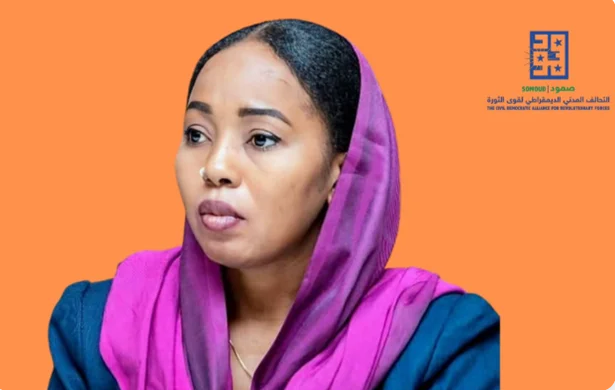
In the midst of the complex Sudanese scene since the April 15, 2023, war, the Civil Democratic Alliance of Revolutionary Forces “Somoud” (Resilience) stands out as an entity seeking to present a new vision for stopping the war and establishing sustainable peace. The alliance includes political forces, trade unions, professional organizations, civil society organizations, social forces, and Resistance Committees that played a pivotal role in overthrowing the June 30, 1989 coup regime. From the heart of these committees emerged university professor and political activist Hoyam Al-Bushra. She steadfastly confronted security agencies and shadow battalions until the Sudanese people succeeded in removing the bloody dictatorial regime in April 2019. When the war broke out, Hoyam was among the large group of Sudanese calling for its immediate end. She left Sudan to participate in the first conference of the anti-war alliance, which resulted in the establishment of the Coordination of Civil Democratic Forces “Taqadum” (Progress). She was elected Deputy Head of the alliance. When a group of forces left “Taqadum” to join the founding alliance, the remaining political and civil forces preserved the same structures under a new alliance named “Somoud.” Hoyam remained Deputy Head of the new alliance, as a symbol of the struggles of the Resistance Committees and the Sudanese woman, who had the greatest impact on the success of the Sudanese Revolution. We review with her the files of war and peace.
First, why did “Somoud” emerge at this specific time, and what distinguishes it from other initiatives, especially amid talk of the “split of Taqadum”?
The Somoud Alliance is “a third path through which we present our vision as independent revolutionary civil democratic forces, completely independent from any of the conflict parties.” Somoud came as a natural outcome of disengaging from previous coalitions. We aim to establish a third path to stop and end wars in the Sudanese state and build sustainable peace through peaceful and negotiated means. We believe that the solution cannot come from the warring parties, but from the will of the Sudanese people and its civil forces.
In many media statements, you say you are seeking to form the largest front to stop the war, and you mentioned that you are working to add other bodies to the alliance and expand the civil front. What are the most prominent efforts you have made in this regard?
We have presented and shared our vision with the public and with active parties in their various supporting bodies that advocate stopping the war. We then held intensive dialogues in several countries, including Uganda, Kenya, and Egypt. In these dialogues, we discussed with youth bodies, civil society organizations, public figures, women’s bodies, and others ways to expand the civil front. We proposed several coordination methods: direct joining of “Sumoud,” coordination on visions and positions, or building a larger and more inclusive front. We also seek coordination in multiple fields such as media, humanitarian work, and diplomatic work, including sending external delegations. We welcomed all recommendations resulting from these discussions and will work to incorporate them into our vision. 2
Is there communication with other political forces or armed movements?
Yes. To expand “Somoud” as a broad civil front, we have maintained continuous communication and coordination since the “Taqadum” period with the Sudan Liberation Army (SLA) led by Abdel Wahid Nour, the Arab Baath Party, and the Popular Congress Party. We believe in the importance of expanding the base of participation to include everyone who believes in the necessity of ending the war and building a democratic Sudanese state.
What are the main pillars of “Somoud”’s vision for stopping the war in Sudan?
Our vision is based on several axes to stop and end wars in the Sudanese state. The most important is addressing the humanitarian catastrophe as an entry point to the political process. This begins with an immediate and unconditional ceasefire under regional and international pressure, with the aim of opening pathways and delivering humanitarian aid. This leads to launching a comprehensive peace process through a political process with three simultaneous tracks operating at the same time:
- First: The Humanitarian Track — focuses on delivering aid and protecting civilians.
- Second: The Ceasefire Track — includes agreement on a permanent ceasefire and security arrangements.
- Third: The Political Track — aims to launch an inclusive national dialogue that addresses the roots of the crisis and establishes sustainable peace. This dialogue will include all parties except the National Congress and its fronts.
We also emphasize the importance of direct communication with the two conflicting parties, urging them that there is no military solution to the country’s problems and calling them to a peaceful negotiated solution. We also work at the regional and international levels to urge them to contribute to addressing the humanitarian catastrophe, strengthening efforts to stop the war, and assisting in the reconstruction mission after peace is achieved.
What are the mechanisms you propose to achieve this comprehensive vision?
To achieve this, we have proposed several means and mechanisms:
- First: The Broad Civil Front — We seek to achieve it by mobilizing popular and political efforts that include all revolutionary and civil democratic transformation forces that stood against the October 25 coup and the April 15 war.
- Second: A Political Process Through a Round Table — a “Sudanese-Sudanese” dialogue that leads to establishing the Sudanese state on new foundations and ending wars within it.
What are the basic principles on which your vision for establishing the Sudanese state is based?
Our vision is based on important foundations and principles to end wars and establish the state: the unity of Sudan as a people and land with full sovereignty over its territory and resources; citizenship without discrimination; building and establishing the security and military system on national foundations; recognition of historical diversity and good management of it; and building a civil, democratic, federal state.
Our vision also includes the tasks, structures, and levels of the foundational transitional period that we consider necessary. Regarding international activism, what are your efforts to support peaceful solutions at this level? Our vision stems from our support for all negotiating platforms seeking peaceful solutions, starting with the Jeddah and Manama platforms and others. Among our latest efforts, we sent several messages supporting the Quad that is holding its meetings in Washington this July. We clarified that this Quad represents a ray of hope for the Sudanese, and we presented our vision for resolving the Sudanese crisis through it.
Finally, what are the most prominent challenges facing your work on the ground inside Sudan?
The Somoud Alliance, as a revolutionary civil extension operating under extremely complex conditions, faces a range of internal challenges that affect its effectiveness and spread. These can be summarized as follows:
First: Security Grip and Multiple Detention Authorities
Security violations have intensified. The security grip has become a direct tool of repression against civil cadres and activists. Multiple agencies carry out arrests (Army Intelligence, Rapid Support Forces, regular police, or even local militias), creating an environment of terror and insecurity. Many activists have been arrested outside the law, subjected to systematic torture, and held in unknown locations.
Second: Systematic Violence as a Tool to Terrorize Society
The phenomenon of systematic violence against activists has grown, especially in areas where civil components are trying to reorganize themselves. Violations include physical assaults, death threats, continuous pursuit, and targeting of families and communities.
Third: Judicial Surveillance and Fabrication of Charges
The judicial apparatus is used as a tool of oppression through fabricated complaints against activists related to information crimes (“espionage,” “undermining the constitutional system,” or “harming the prestige of the state”). These charges pose a real threat to freedoms, as legal defense is difficult in a collapsed or politicized judicial environment.
Fourth: Media Challenges and Smear Campaigns
State agencies and their media arms carry out systematic campaigns to distort the image of civil and revolutionary forces. They portray Resistance Committees, unions, and civil entities as “agents or foreign tools,” which has contributed to creating social isolation and popular hesitation toward revolutionary work.
Fifth: Human Drain and Leadership Vacuum
Repression, lack of protection, and deteriorating living conditions have caused a wide wave of migration of first-tier political and professional cadres. This has negatively affected organizational and coordination work inside Sudan and created a leadership vacuum in civil bodies, including Resistance Committees, parties, unions, civil society, and prominent figures.
Sixth: Social and Economic Challenges Linked to the War
The war has led to a deterioration of living conditions, shifting popular priorities toward survival and livelihood at the expense of public work and political organizing. Humanitarian crises have scattered grassroots communities and imposed displacement and asylum, making it difficult to build cohesive bases for the alliance.



