Cairo – Sudan Scope
The importance of art as a soft power that can transcend barriers and unite souls stands out clearly. Art, with its universal language that goes beyond words, becomes an effective tool for understanding between peoples and building bridges of dialogue that reinforce values of tolerance and openness. It is a shared space for exchanging experiences and visions, offering us a window into understanding different human experiences from a deep and visual perspective.
Sudanese Plastic Art: Documenting the Nation’s Memory
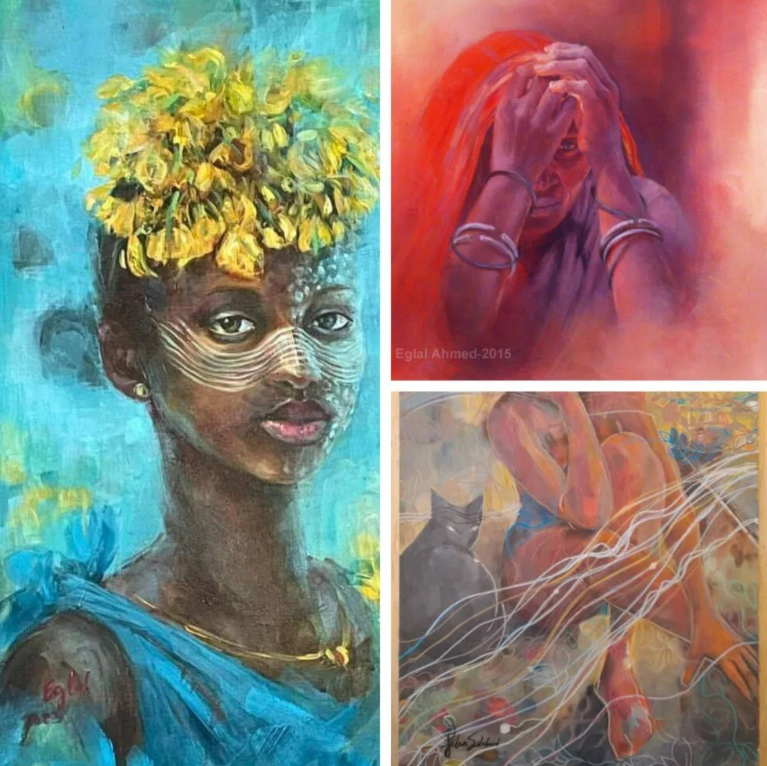
In a deep dialogue with several female plastic artists about the role of plastic art, they affirmed that this field of art is not merely a means of beauty but has been a fundamental contributor to consolidating Sudanese awareness of their identity. Sudanese artists have drawn inspiration from the treasures of ancient heritage and civilizations such as Kush, Meroe, and Nubian civilization, in addition to the rich folk legacy. They have transformed colors and symbols into visual messages that embody the features of Sudanese personality and instill a sense of pride and belonging.
The artists added that since the establishment of the College Institute, pioneers of modern art such as Ibrahim El-Salahi and Kamala Is'haq emerged. They led an artistic movement that reflected Sudan’s rich cultural and heritage diversity. Plastic art has become a visual record documenting the diversity of tribes and the distinctive features of identity, while combating attempts to erase them.
In our conversation with the institutions of the Association of Sudanese Female Plastic Artists, they noted that the ethnic and cultural diversity in Sudan is an inexhaustible source of inspiration for artists. This diversity has been reflected in their works using traditional decorations, folk heritage, and the human features of different population groups. From palm frond works in the West, to Nubian engravings in the North, and jewelry designs in the East, a unique artistic painting has been formed that reflects the unity of the Sudanese fabric despite the multiplicity of its components.
The Association of Sudanese Female Plastic Artists: A Return for the Sake of the Homeland
Despite more than two decades since its establishment, the question “Why female plastic artists?” remains relevant. The association was founded to highlight the role of Sudanese female plastic artists, encourage them, and create a free and supportive space for them to express their visions in a society where women’s creativity may face special challenges.
Female plastic artists are distinguished by their ability to employ personal experience and refined sensitivity in their works, which adds deep human and emotional dimensions to the artistic scene. The association has played an important organizational role in protecting their rights and developing their skills through workshops and exhibitions, thus becoming both an artistic and a union platform at the same time.
The association’s activities stopped for years due to financial challenges and the general conditions that Sudan went through. However, the spirit of collective work remained alive among its members. With the recent return of activity, a new role for the association has emerged in alleviating the effects of war on the national fabric by using art as a tool for dialogue and rapprochement and producing artworks that call for tolerance and coexistence.
Art in Time of War: Preserving the Nation’s Memory and a Voice of Resistance
In times of war, plastic art acquired a pivotal role in preserving both tangible and intangible heritage threatened with extinction. The artist becomes a visual historian who documents archaeological landmarks, folk customs, traditional clothing, and handicrafts, protecting the collective memory from fading. Even in the diaspora, the Association of Sudanese Female Plastic Artists works to document and protect this heritage through social media and joint efforts, organizing exhibitions and cultural events inside and outside Sudan. This diligent endeavor is an attempt to ensure the continuity of the heritage and protect it from oblivion.
If weapons are the language of war, art can fight it with another language. Art is not a luxury in times of conflict; rather, it is a means of cultural resistance, building bridges of understanding, and rebuilding the social fabric.
Art is the voice of hope that transforms pain into messages of strength and reminds us that peace is the common destiny we all strive for.



